

Digital Twin and 3D Scanning for Modern Data Centers in Germany
Germany is one of the leading data center markets in Europe and plays a critical role in the continent’s digital infrastructure. The rapid growth of cloud computing, artificial intelligence, enterprise IT, and data-driven services continues to drive investment in new facilities and infrastructure modernization.
Cities such as Frankfurt, Berlin, Munich, Hamburg, Stuttgart, Cologne, and Düsseldorf have become strategic locations for data center development. Frankfurt, in particular, is widely recognized as one of Europe’s most important data center hubs due to its connectivity, financial sector concentration, and international network infrastructure.
Kontaktieren Sie uns jetzt für eine kostenlose Beratung!
As data center capacity continues to expand, operators face growing pressure to maintain accurate documentation, coordinate complex engineering systems, and plan future upgrades without disrupting operations.
The Challenges of Managing Modern Data Centers
Modern data centers are among the most complex building environments in operation today. They contain thousands of interconnected assets that must function continuously and reliably.
Typical infrastructure includes:
- server rooms;
- cooling systems;
- electrical distribution networks;
- UPS systems;
- backup generators;
- fire protection systems;
- cable trays;
- security infrastructure;
- building management systems.
Many facilities have been expanded or modified over time, making original documentation incomplete or outdated. Even small discrepancies between existing conditions and available drawings can create challenges during modernization projects.
For mission-critical environments, accurate digital information is no longer optional—it is essential.
3D Laser Scanning for Data Centers
High-precision 3D laser scanning services have become one of the most effective ways to capture existing conditions within active data centers.
Using advanced reality capture technology, millions of measurements can be collected to create an accurate digital representation of the facility.
Laser scanning is commonly used for:
- server room scanning;
- equipment documentation;
- MEP coordination;
- cable tray verification;
- cooling infrastructure surveys;
- renovation planning;
- facility expansion projects.
In major German markets such as Berlin, Munich, and Hamburg, laser scanning allows project teams to work with verified geometry rather than assumptions.
Accurate scan data reduces project risk and improves coordination between architects, engineers, contractors, and facility managers.
Creating a Digital Twin for Data Center Infrastructure

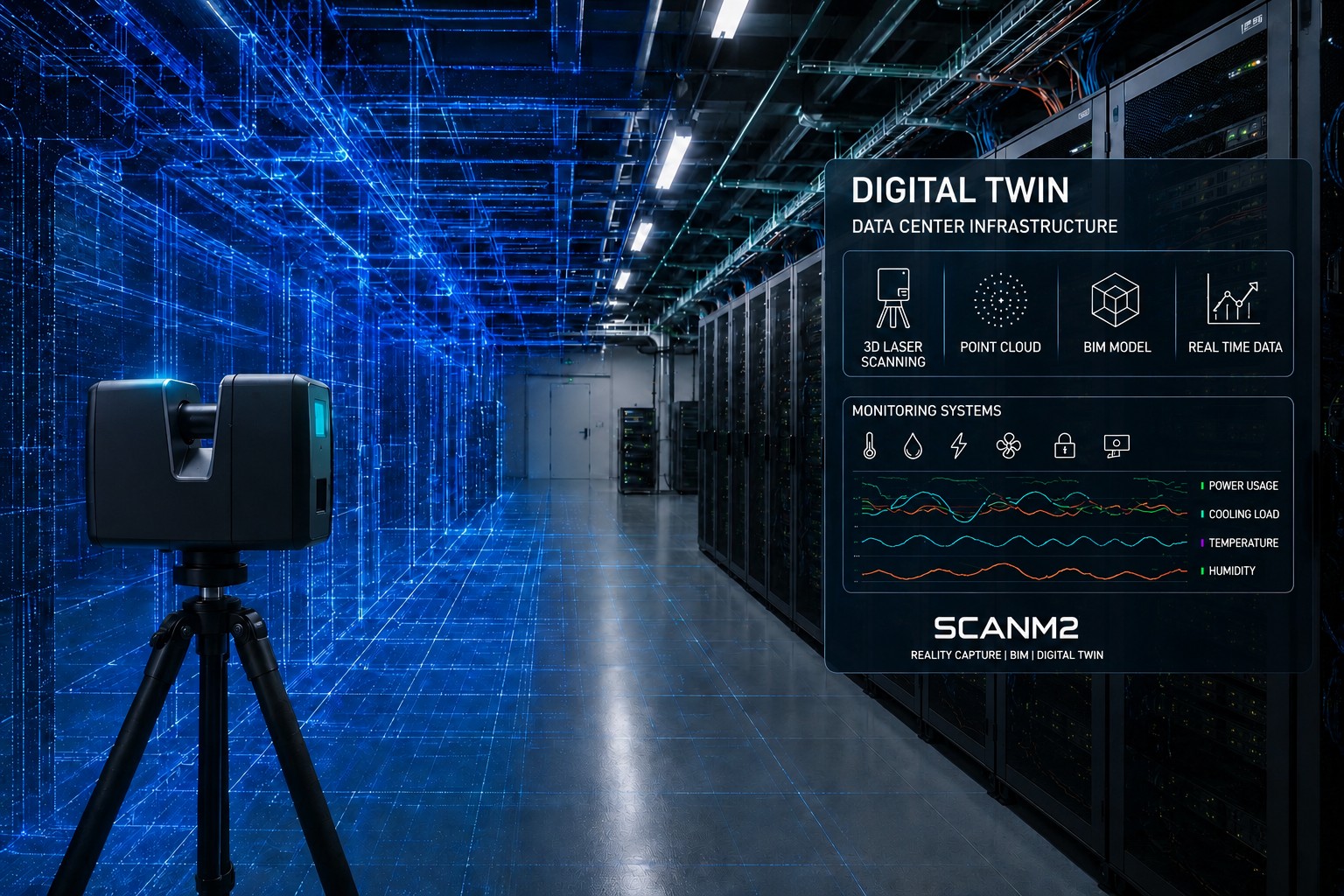
A Digital Twin is far more than a 3D model. It is a digital representation of a physical facility that can be connected to operational data, maintenance information, and asset management systems.
For modern data centers, Digital Twin environments provide:
- accurate spatial information;
- centralized asset documentation;
- engineering coordination;
- infrastructure visualization;
- maintenance planning;
- lifecycle management support.
Digital Twin solutions are becoming increasingly valuable for facilities in Frankfurt, Berlin, and Munich, where operators manage highly complex and continuously evolving infrastructure.
By combining laser scanning, BIM modeling, and operational data, organizations gain greater visibility into the performance and condition of their facilities.
Point Cloud to BIM for Mission-Critical Facilities
The point cloud generated during laser scanning serves as the foundation for BIM development.
Point Cloud to BIM workflows allow existing facilities to be transformed into structured digital models that support engineering, planning, and operations.
Typical deliverables include:
- architectural BIM models;
- structural BIM models;
- MEP BIM models;
- Revit models;
- IFC models;
- existing conditions models;
- as-built BIM documentation.
For mission-critical facilities throughout Germany, BIM models provide a reliable source of information for renovation, expansion, and infrastructure management projects.
Accurate BIM environments also support clash detection, design coordination, and future digital twin initiatives.
These workflows are often delivered as part of larger Scan to BIM services for renovation, expansion, and infrastructure modernization projects.
Reality Capture and Existing Conditions Documentation
Many data center projects begin with a simple challenge: the available drawings no longer match reality.
Years of modifications, equipment upgrades, and infrastructure changes often result in documentation gaps.
Reality capture technologies help solve this problem by creating accurate existing conditions documentation directly from measured data.
These workflows support:
- as-built documentation;
- facility surveys;
- modernization planning;
- engineering assessments;
- infrastructure audits;
- digital transformation projects.
For facilities in Cologne, Düsseldorf, Frankfurt, and other German markets, accurate documentation provides the foundation for better project decision-making.
How Digital Twins Improve Data Center Operations
The value of a Digital Twin extends well beyond design and construction.
Once implemented, a digital twin can support ongoing operations by providing accurate information about building systems, equipment, and infrastructure.
Benefits include:
- improved facility management;
- faster maintenance planning;
- enhanced asset tracking;
- reduced operational risk;
- better space utilization;
- improved change management;
- more efficient infrastructure upgrades.
As German data center operators continue investing in smart infrastructure, digital twins are becoming an increasingly important part of long-term operational strategy.
Germany’s Key Data Center Locations
Frankfurt
Frankfurt remains Germany’s most important data center market and one of the largest connectivity hubs in Europe. Digital Twin solutions, BIM workflows, and laser scanning technologies are increasingly used to support expansion and modernization projects throughout the region.
Berlin
Berlin continues to attract technology companies, cloud providers, and digital infrastructure investments. Accurate laser scanning and digital twin development help support the growth of complex facilities in the area.
Munich
Munich is an important technology and innovation center where data center operators are investing in modernization, infrastructure optimization, and facility management technologies.
Hamburg
Hamburg’s strategic location and industrial infrastructure make it an important market for data center development and engineering documentation services.
Stuttgart
As a major industrial and technology region, Stuttgart continues to see increasing demand for digital documentation, BIM modeling, and infrastructure modernization.
Cologne and Düsseldorf
Organizations across Cologne and Düsseldorf are adopting reality capture, BIM, and digital twin technologies to improve facility management and support future infrastructure growth.
Why Accurate Digital Documentation Matters
Data centers operate in environments where precision is critical.
Inaccurate drawings, missing documentation, and incomplete engineering information can lead to:
- coordination conflicts;
- costly redesigns;
- installation errors;
- project delays;
- operational risks.
By combining laser scanning, point cloud processing, BIM modeling, and digital twin technologies, facility owners gain access to accurate, measurable, and continuously usable information.
This creates a stronger foundation for both current operations and future development.
Why ScanM2
ScanM2 provides comprehensive services for data center documentation, BIM development, and digital twin creation.
Our expertise includes:
- 3D laser scanning;
- point cloud processing;
- Point Cloud to BIM;
- BIM modeling;
- as-built documentation;
- digital twin development;
- existing conditions documentation;
- facility modernization support.
We help owners, operators, engineers, and consultants create reliable digital environments for mission-critical facilities across Germany and internationally.
Planning a Data Center Project in Germany?
Whether you are developing a new facility, expanding an existing data center, or implementing a Digital Twin strategy, accurate information is the foundation of every successful project.
ScanM2 delivers laser scanning, BIM modeling, Point Cloud to BIM, digital twin development, and as-built documentation services for data centers and mission-critical facilities throughout Germany.
Contact our team to discuss your next project.

