

3D Inventory of a Service Building in the Mountains – Example of Laser Scanning a Functioning Hotel
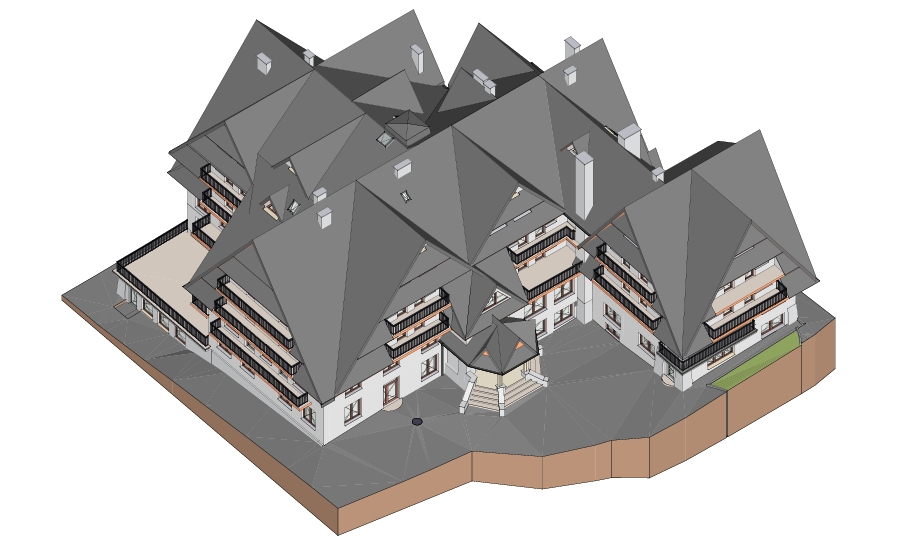
Location: Hotel building in the Tatra Mountains region, near Zakopane
Type of building: Multi-story hotel
Scope of services: 3D scanning, floor plans, cross-sections, elevation drawings, 3D model in .pln/.pla files
Floor area of the scanned building: approx. 2300 m²\24,757 sq ft
Project
As part of an order for a hotel investor located in the picturesque Tatra Mountains region, we performed a comprehensive 3D scan of the hotel building. The multi-story structure was scanned with the highest accuracy to prepare complete technical documentation in both flat (2D) and spatial (3D) formats.
Initially, the investor planned to order only an inventory of the interiors, as the main purpose of the project was to replace windows and doors. However, during discussions and after presenting the scope of possibilities and cost analysis, the investor decided to have the entire building documented. These materials will be used in the future as a basis for further projects, obtaining permits, interior design work, and other renovation and construction activities.
Software: The model was developed in Archicad, data was collected using Trimble X7 and Faro Focus S70 scanners, and then processed using Faro Scene.
Completion time: 2 days of scanning (2 employees), 3 weeks of preparing all documentation.
Characteristics of the building
The building consists of two sections with distinct geometry and floor configurations, connected only on a single level. The difference in height layouts and the functional separation of the volumes required an individual approach to documenting each part. An additional challenge was the complex geometry of the staircase.
The architecture of the Zakopane region is characterized by highly complex roofs – numerous slopes, dormers, dynamic angles of inclination, and often asymmetrical structural arrangements. Roofs in this type of building tend to be fragmented, multi-pitched and irregular, which requires precise measurement and experience in interpreting scan data. In this project, it was also important to accurately reproduce the geometry of the roofs at the transition points between the two building structures and at the points of contact with dormers and parapets.
Modeling process
Initially, we focused on modeling the interior and functional layout, and then moved on to the roof structure. Data from ground scans was used to recreate its geometry, supplemented by material from a drone flight, which provided a better understanding of the complex structure of the roof. The documentation of the top floor was prepared with visible shapes of ceilings and roof slopes (slopes, curves, arched ceilings).
Scope of documentation
The project included the preparation of a complete set of technical documentation based on laser scans, including:
- Accurate floor plans (basement – 5th floor) with usable and functional areas marked.
- Roof plan including slopes, dormers, roof breaks and geometric shapes specific to the Zakopane region.
- Vertical sections illustrating the relationships between levels, varying ceiling heights and the building’s layout.
- Building elevations (4 sides) presented in a way that facilitates technical and aesthetic assessment of the building.
- 3D BIM model in LOD250 standard, taking into account complex architectural details and height differences in two parts of the building.
In the documentation, particular emphasis was placed on the reproduction of doors and door openings, windows and window openings, which resulted directly from the purpose of the project, which included the planned replacement of window and door frames. Inspection recesses were also shown, including openings and hatches for electrical and fire cabinets, ceiling shapes, roof slopes, and the irregular surroundings of the ground floor.
Result: Drawings and BIM model
2D DOCUMENTATION


3D \ BIM MODEL


SCANNING PROCESS


Results
The investor received a set of documentation that can be used at many stages of the investment process – from the planned replacement of window and door joinery, through interior design, to obtaining building permits and cooperation with contractors. The BIM model and 2D projections give them full control over the geometry of the building and provide a ready-made basis for further design, renovation, and analytical work.
Our efficient and cost-effective scanning process
In the industry, there is a common belief that 3D laser scanning is an expensive service. ScanM2 effectively debunks this myth by offering solutions that combine high quality with competitive prices. Thanks to the use of state-of-the-art scanners and efficient working methods, we are able to carry out measurements faster than with traditional manual techniques, while delivering a precise and ready-to-use model in less time and at a lower cost.
Why choose ScanM2?
ScanM2 is a team of specialists with many years of experience in 3D scanning, architectural digitization, and BIM documentation. We work with investors from various sectors, from architects and interior designers to engineers and property managers.
- Unrivalled precision: Measurements with an accuracy of 3–5 mm thanks to the use of Trimble X7, Faro Focus S70, and Leica C10 scanners, as well as a handheld scanner for hard-to-reach details – with millimeter accuracy, ideal for documenting decorative elements, installations, and irregular surfaces.
- Fast turnaround time: Thanks to our optimized workflow, we are able to deliver data faster than traditional measurement methods.
- BIM modeling at various levels of detail (LOD): Depending on the customer’s needs, we create models ranging from conceptual to detailed, including LOD250.
- Flexibility and customization: We work with both contemporary and historic buildings, adapting the scope and method of work to each project.
- Support at every stage: We help you understand the data, use the model, and export it to the appropriate format if necessary.
- Added value: As part of each project, we provide our clients with a point cloud and photographic documentation of the object free of charge – these are invaluable aids for further analysis, design, and communication with contractors.
Frequently asked questions (FAQ)
Was the object open during scanning?
Yes, the scanning was performed in a functioning hotel, which confirms that such work can be carried out without interrupting operations.
What equipment was used?
Professional long-range laser scanners and Faro Scene software were used for data capture and initial processing.
Can the data be used in future BIM projects?
Yes, the data was processed in Archicad and can be exported to popular BIM formats (e.g., IFC) used by architects and engineers.
Is it possible to scan other types of buildings to a similar standard?
Of course, we offer scanning services for office, industrial, residential, religious, commercial, and many other types of buildings, always taking an individual approach to the specifics of each project. We have also scanned train cars, yachts, car parts, sculptures, cemetery grounds, and many other unusual objects

Do you have a similar project or questions about pricing?
Contact us via the contact form on our website or call us directly – you will find our contact details in the footer of the website. We will be happy to advise you and prepare an individual offer. We will also answer all your questions about 3D scanning, BIM documentation, and service pricing.

