
Scan to BIM Services: Laser Scan & Point Cloud to Revit BIM Modeling
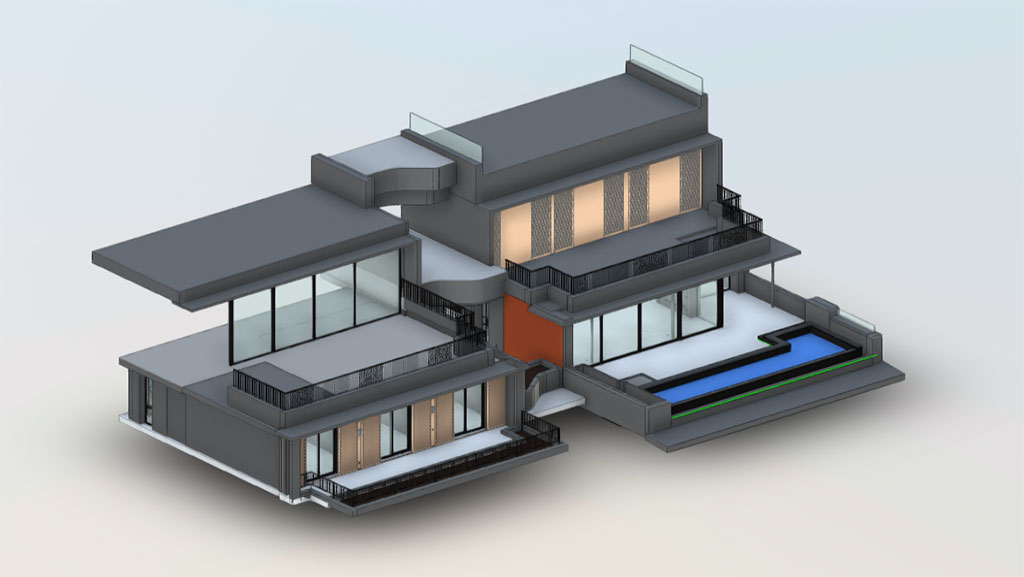
ScanM2 provides Scan to BIM services for architects, engineers, contractors and building owners. We laser scan existing buildings and turn the point cloud into accurate Revit models – or model directly from a point cloud you already have. Every project starts with a clear scope: which disciplines, which level of development (LOD) and which deliverables your team really needs.
- Architectural, structural and MEP BIM models from laser scans
- LOD 200–500, agreed per discipline before modeling
- Revit, IFC, Navisworks and DWG deliverables
- Most projects delivered within 1–3 weeks
- Projects across the USA and worldwide
Contact Us Now for a Free Consultation!
What Is Scan to BIM?
Scan to BIM is the process of capturing an existing building with a 3D laser scanner and converting the resulting point cloud into a Building Information Model. Instead of measuring by hand or relying on old drawings, the design team works from a model built on millions of measured points.
The result is an intelligent model with walls, floors, roofs, structural members, ducts and pipes as real BIM objects. It can be used for renovation design, clash detection, quantity take-off, construction verification and long-term facility management.
Our Scan to BIM Services
Architectural Scan to BIM
Walls, floors, ceilings, roofs, doors, windows, stairs and façades modeled from the scan. Ideal as a basis for renovation, tenant fit-out and change-of-use projects.
Structural Scan to BIM
Columns, beams, slabs, trusses, foundations visible on site and steel connections where required. Engineers get the real grid, real member sizes and real deviations instead of design assumptions.
MEP Scan to BIM
Ductwork, piping, cable trays, equipment and fixtures in plant rooms, ceilings and shafts. MEP models support coordination of new systems inside existing buildings and help avoid clashes on site.
Point Cloud to BIM From Your Data
Already have a scan? We accept registered point clouds from Leica, FARO, Trimble, NavVis and other scanners and handle point cloud modeling remotely. We review the data first and point out gaps before work starts.
As-Built Drawings From the Model
Floor plans, sections and elevations can be generated from the same model, so as-built drawings and BIM stay consistent.
Level of Development (LOD) in Scan to BIM
The LOD defines how much detail each element carries. Choosing the right level keeps the model useful without paying for detail you will never use. We agree it per discipline and, where needed, per area of the building.
- LOD 200 – main elements with approximate size and position. Good for massing, feasibility studies and space planning.
- LOD 300 – elements with accurate geometry, size and location. The standard choice for renovation design and permit drawings.
- LOD 350 – LOD 300 plus connections and interfaces between systems. Used for MEP coordination and clash detection.
- LOD 400 – fabrication-level detail for selected elements, such as steel members or prefabricated MEP assemblies.
- LOD 500 – a verified as-built model with the information required for facility management.
Our Scan to BIM Process
- Scope and data review. We agree disciplines, LOD, accuracy expectations, Revit template and deliverables. If you supply a point cloud, we check its coverage and quality.
- 3D laser scanning. When we capture the site, we use terrestrial laser scanners and plan scan positions to cover every area required by the scope.
- Registration and point cloud preparation. Scans are aligned into one coordinate system, cleaned and split by level or zone for modeling.
- BIM modeling. Our team models architecture, structure and MEP in Revit using your standards and naming conventions.
- Model-to-scan check. We compare the model with the point cloud to make sure elements follow the measured geometry.
- Delivery and support. You receive the model, drawings and point cloud in the agreed formats. We answer questions and make adjustments after delivery.
Deliverables and File Formats
- BIM models – Revit (RVT) in your required version, IFC for openBIM workflows
- Coordination models – Navisworks (NWD/NWC)
- 2D drawings – floor plans, sections and elevations in DWG or PDF
- Point cloud – registered data in E57, RCP/RCS, LAS or other formats
- Custom content – Revit families and parametric objects where the project needs them
Examples of Our 3D Scan to BIM Projects
Our 3D Scan to BIM Examples


Where Scan to BIM Is Used
- Renovation and retrofit – design new layouts around the real structure and existing services.
- MEP upgrades – plan new ducts, pipes and equipment in crowded plant rooms and ceiling voids.
- Construction verification – compare what was built with the design model before closing walls and ceilings.
- Historic buildings – record irregular geometry and ornament without touching the building.
- Facility management – keep an accurate digital record of the building for maintenance and future projects.
Scan to BIM Cost
Every building is different, so we price Scan to BIM projects individually and send a fixed quote before any work starts. The main factors are:
- Floor area and number of levels
- Complexity – open warehouses are faster to model than hospitals, laboratories or historic interiors
- Disciplines – architecture only, or architecture, structure and MEP
- Required LOD for each discipline
- Scanning – whether we capture the site or work from your point cloud
- Deliverables – model only, or model plus drawings, families and IFC exports
To get an accurate quote, send us the building address or type, the approximate floor area, the disciplines and LOD you need and, if available, a sample of your point cloud. Contact us and one of our experts will get back to you within 24 hours.
For new design and coordination projects, see our BIM modeling services.
Software and Equipment
- Autodesk Revit – modeling, families, templates and drawings
- Navisworks – coordination and clash detection
- AutoCAD – 2D drawings and CAD deliverables
- ArchiCAD and IFC – openBIM data exchange
- Leica, FARO, Trimble and Matterport scanners for capture
Why Work With ScanM2?
- Scanning and modeling under one roof – one team responsible from site visit to final model
- Scope agreed up front – LOD, accuracy and deliverables fixed before work starts
- Your standards – we work in your Revit template, version and naming conventions
- Fast turnaround – most projects delivered within 1–3 weeks
- Worldwide service – remote modeling from point clouds supplied from any country
Get a Free Quote for Your Scan to BIM Project
Tell us about your building and what the model will be used for. We will recommend the right LOD and deliverables and send a fixed quote. Request a quote today.
Scan to BIM by Industry
We provide scan to BIM for a wide range of facility types. See how the service works for your industry:
Energy facilities: Condensing Power Plants, Power Transmission Lines, Hydroelectric Power Stations, Nuclear Power Plants, Open-Type Switchgear, Thermal Power Stations
Industrial facilities: Oil and Gas Production, Chemical Manufacturing, Machine-Building Enterprises, Metallurgical Complexes, Workshops and Production Areas
Transport infrastructure: Tunnels, Roads and Highways, Bridges and Overpasses
Commercial and residential buildings: Stadiums, Shopping Malls, Office Buildings, Warehouses, Residential Buildings
Cultural heritage: Churches and Temples, Historical Buildings, Architectural and Archaeological Monuments, Theaters and Museums
Quarries and mines: Open-Pit Quarries, Ore Processing Plants

