

Using Point Clouds for MEP BIM Modeling
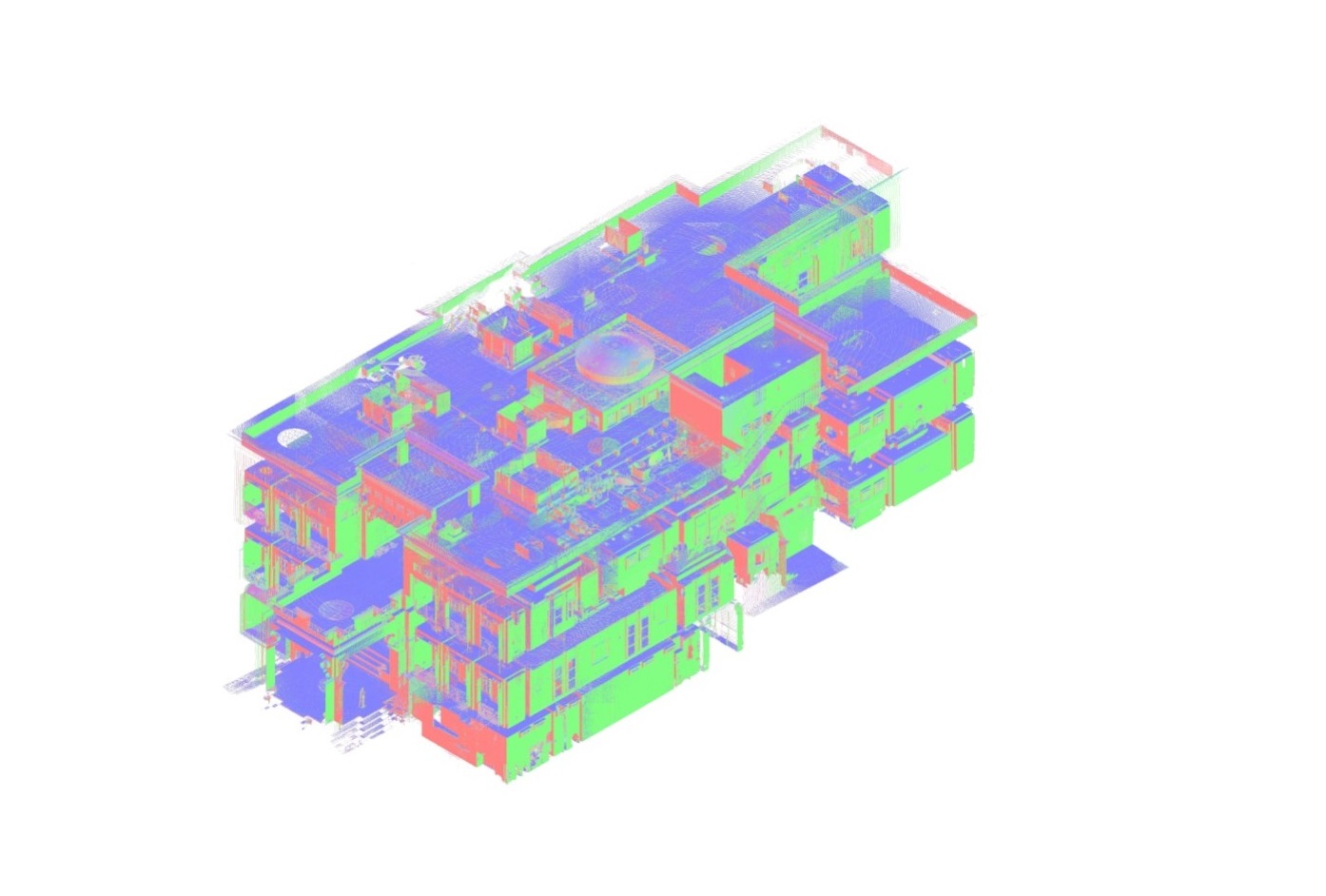

Modern building engineering increasingly relies on point clouds for MEP BIM modeling to ensure precision, coordination, and constructability. As projects become more complex—especially in renovation and retrofit environments—traditional measurement methods are no longer sufficient.
Today, MEP BIM modeling from point cloud data has become the standard approach for capturing existing conditions and translating them into coordinated digital models. Whether the objective is coordination, documentation, or digital twin development, point cloud to BIM MEP workflows enable engineers to build accurate models of mechanical, electrical, and plumbing systems directly from reality capture.
In this article, we explore how scan to BIM for MEP systems works, why it matters, and how it improves project outcomes.
What Is a Point Cloud in MEP BIM Projects?
A point cloud is a high-density collection of spatial data points captured through terrestrial laser scanning. Each point contains precise XYZ coordinates and, in many cases, RGB color data. Together, these points form a three-dimensional representation of physical spaces and building systems.
In MEP projects, point clouds are used to document:
- Mechanical systems modeling (HVAC units, chillers, piping)
- Electrical trays and conduit routing
- Plumbing stacks and pipe networks
- Ceiling void scanning for concealed services
- Structural interfaces affecting MEP coordination BIM
Unlike manual measurements, point cloud data in construction captures millions of points within minutes, allowing engineers to build models based on real-world geometry instead of assumptions.
Why MEP BIM Modeling Requires Point Cloud Data
One of the most common questions is why MEP modeling requires laser scanning. The answer lies in accuracy and coordination.
Without laser scanning:
- Hidden clashes go undetected
- Pipe slopes are miscalculated
- Ductwork routing optimization becomes guesswork
- Existing conditions MEP modeling relies on outdated drawings
- Field rework increases
In complex environments—especially hospitals, industrial plants, or renovation projects—manual tape measurements simply cannot capture irregular geometries or congested spaces.
By contrast, BIM modeling from laser scan data ensures:
- Model alignment with true geometry
- Reliable piping layout verification
- Improved clash detection using point cloud references
- Reduced RFIs and field conflicts
This is why many engineering teams integrate professional 3D laser scanning services at the early project stage.
Scan-to-BIM Workflow for MEP Systems

Understanding how to use point cloud for MEP BIM requires breaking down the workflow into clear steps.
1. 3D Laser Scanning of Existing Conditions
The process begins with high-resolution terrestrial laser scanning. Multiple scan stations are placed throughout the facility to capture full coverage, including mechanical rooms and ceiling cavities.
The resulting raw scan data captures millimeter-level detail and serves as the foundation for as-built MEP modeling.
Many projects begin with a structured scan to BIM workflow , ensuring proper data capture strategy.
2. Point Cloud Registration and Alignment
Individual scans must be stitched together through point cloud registration. This step:
- Aligns scan stations
- Removes noise
- Establishes coordinate systems
- Enables accurate model alignment
Proper registration ensures millimeter accuracy across the entire dataset.
3. BIM Modeling of MEP Systems
Once aligned, engineers begin MEP BIM modeling from point cloud data.
Using BIM software, specialists trace:
- Ductwork
- Piping systems
- Cable trays
- Equipment geometry
The process results in a structured BIM model representing real as-built conditions. This stage is often part of broader BIM services , especially when coordination and documentation are required.
4. Clash Detection and Coordination

With an accurate model in place, teams perform:
- Clash detection using point cloud references
- MEP coordination BIM across trades
- Structural interference validation
- Clearance verification
This structured point cloud workflow for BIM coordination dramatically reduces costly on-site conflicts.
Accuracy of Point Cloud-Based MEP Modeling
Accuracy is a key advantage of scan-based MEP design.
| Measurement Method | Typical Tolerance | Risk Level | Recommended Use |
| Manual tape measurement | ±10–20 mm | High | Small simple spaces |
| Total station survey | ±5–10 mm | Medium | Structural layout |
| Laser scan-based modeling | ±2–5 mm | Low | Complex MEP systems |
When Millimeter Accuracy Matters
Millimeter accuracy becomes critical when:
- Connecting new systems to existing infrastructure
- Verifying pipe slopes
- Performing piping layout verification
- Coordinating dense ceiling zones
- Developing a digital twin
In retrofit projects, even small deviations can result in fabrication errors.
Using Point Clouds for MEP Retrofit and Renovation Projects
Retrofit projects represent one of the strongest use cases for point cloud to BIM MEP.
Renovation environments often lack:
- Accurate as-built drawings
- Updated MEP documentation
- Reliable equipment dimensions
Using point cloud modeling services, engineers can capture existing conditions before design begins.
Benefits of scan to BIM for MEP in retrofit projects include:
- Reduced demolition risk
- Accurate existing conditions MEP modeling
- Improved ductwork routing optimization
- Faster approval cycles
- Enhanced contractor coordination
This makes scan-based workflows essential for healthcare upgrades, industrial expansions, and commercial renovations.
Common Challenges in MEP Modeling Without Point Cloud
Projects that skip scanning frequently encounter:
- Misaligned models
- Repeated site visits
- Fabrication delays
- Incomplete clash detection
- Inaccurate ceiling void assumptions
Traditional documentation rarely reflects true field conditions. Over time, undocumented modifications accumulate, creating discrepancies between drawings and reality.
Point cloud data in construction eliminates this uncertainty.
Choosing Professional Scan-to-BIM Services for MEP
When selecting a provider for scan to BIM for MEP systems, consider:
- Experience with mechanical systems modeling
- Proven point cloud registration workflows
- Documented tolerance standards
- Expertise in MEP coordination BIM
- Familiarity with retrofit projects
Professional providers integrate point cloud to BIM MEP workflows into structured engineering processes, ensuring consistency, quality control, and accurate deliverables.
A specialized scan-to-BIM partner bridges the gap between raw scan data and coordinated engineering models.
FAQ
What is point cloud to BIM for MEP?
Point cloud to BIM for MEP is the process of converting 3D laser scan data into a structured BIM model that represents mechanical, electrical, and plumbing systems with real-world accuracy.
How accurate is MEP modeling from laser scans?
When properly registered, laser scans can achieve ±2–5 mm tolerance, providing millimeter accuracy suitable for fabrication, coordination, and retrofit integration.
Is scan-to-BIM necessary for renovation projects?
In renovation and retrofit projects, scan-to-BIM is highly recommended because existing drawings are often outdated or incomplete. Laser scanning ensures accurate documentation before new design begins.
Can point clouds improve clash detection?
Yes. Clash detection using point cloud data enables engineers to validate new designs against actual site conditions, significantly reducing field conflicts.
What software is used for MEP modeling from point clouds?
Common tools include Autodesk Revit, Navisworks, Recap, and other BIM platforms capable of handling large point cloud datasets and performing MEP coordination BIM workflows.

