

What Is HBIM and How It Is Used for Historic Buildings
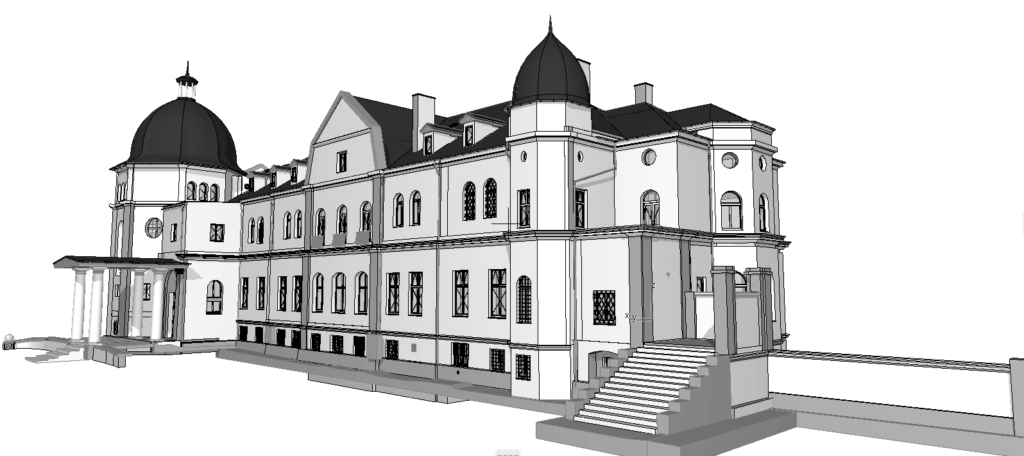

HBIM, or Historic Building Information Modeling, is a digital workflow used to document, analyze, model, and manage historic buildings through structured BIM-based methods. Unlike conventional BIM, which is often developed for new construction, HBIM for historic buildings focuses on existing structures with architectural, cultural, and historical value. These buildings often contain irregular geometry, undocumented modifications, aging materials, and complex construction details that require a more careful and data-driven approach.
In practical terms, historic building information modeling combines measured survey data, geometric modeling, documentation, and building information into a digital model that supports restoration, conservation, renovation, and long-term heritage management. For project teams working with historic assets, HBIM creates a structured way to move from raw survey information to a usable digital building model.
For many heritage projects, this process builds on workflows closely related to broader BIM modeling services, but with a much stronger emphasis on existing conditions, historical accuracy, irregular geometry, and preservation-oriented documentation.
What Is HBIM
HBIM stands for Historic Building Information Modeling. It is used to create digital models of historic buildings that reflect not only visible geometry, but also the information needed for documentation, restoration planning, condition assessment, and heritage management.
A standard BIM model for a new building is usually developed from design intent. An HBIM model, by contrast, is developed from the real condition of an existing structure. This means the workflow often starts with survey-based inputs rather than design drawings. Walls may not be perfectly straight, floors may have deformations, historic elements may vary from one area to another, and documentation may be incomplete or outdated.
Because of this, HBIM historic buildings require a different approach than typical new-build BIM workflows. The model must represent measured conditions as accurately as possible while remaining usable for architectural, engineering, and conservation work.
Why HBIM Matters for Historic Buildings

Historic buildings are rarely simple to document. Many have gone through multiple interventions over time, and original documentation is often missing, inaccurate, or incomplete. As a result, restoration and renovation decisions cannot rely only on assumptions or fragmented archival records.
This is where HBIM for historic buildings becomes especially valuable. A well-developed HBIM model helps project teams:
- understand the actual geometry of the structure,
- document architectural and construction details,
- organize information about building elements,
- support restoration and conservation planning,
- improve coordination between architects, engineers, and heritage specialists,
- create a digital basis for future maintenance and management.
Instead of treating a historic building as a static object, HBIM turns it into a structured digital resource that can support multiple stages of project work.
How HBIM Is Created
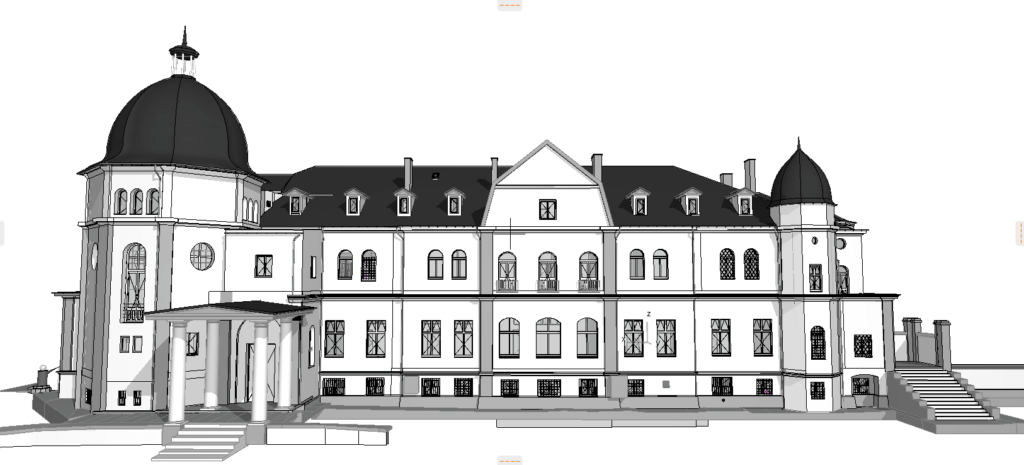
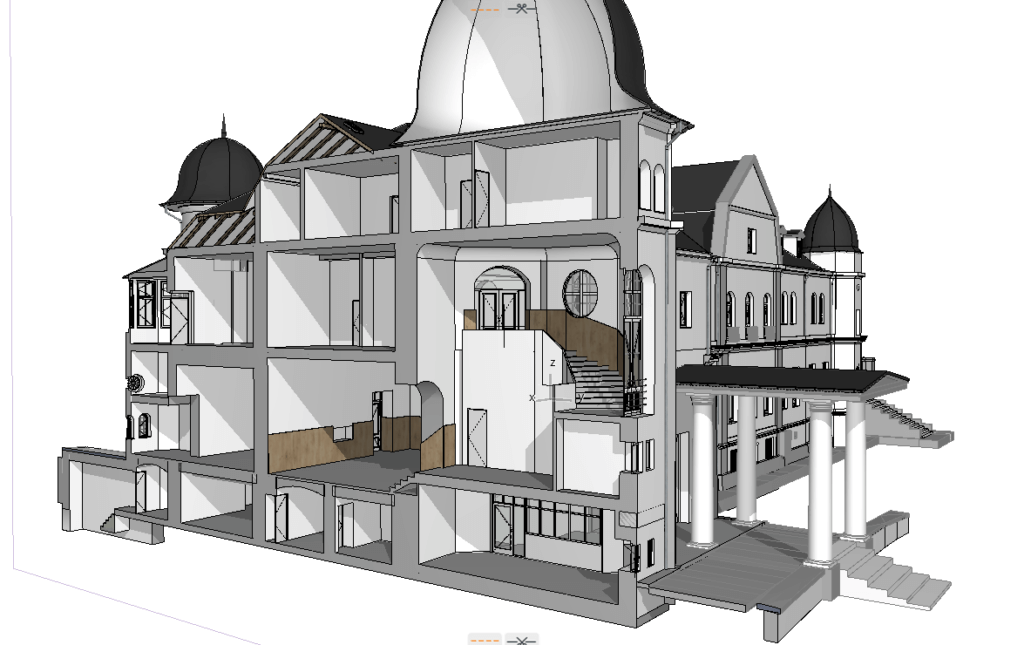
In most cases, HBIM for heritage projects begins with accurate site capture. Historic structures often contain non-standard dimensions, decorative features, uneven surfaces, settlement-related distortions, and hidden complexities that cannot be reliably documented through traditional hand measurement alone.
That is why data collection for HBIM usually depends on 3D laser scanning services and structured point cloud services. These methods provide dense and measurable spatial data that can be used to reconstruct the actual form of the building.
A typical HBIM workflow includes:
- survey planning and site capture,
- generation and registration of point cloud data,
- interpretation of measured geometry,
- development of a digital building model,
- integration of project information and documentation logic,
- preparation of outputs for restoration, renovation, or conservation workflows.
From a process perspective, this is closely related to Scan to BIM services, especially in projects where measured data must be translated into coordinated digital building models for further project use.
Point Cloud to HBIM Workflow
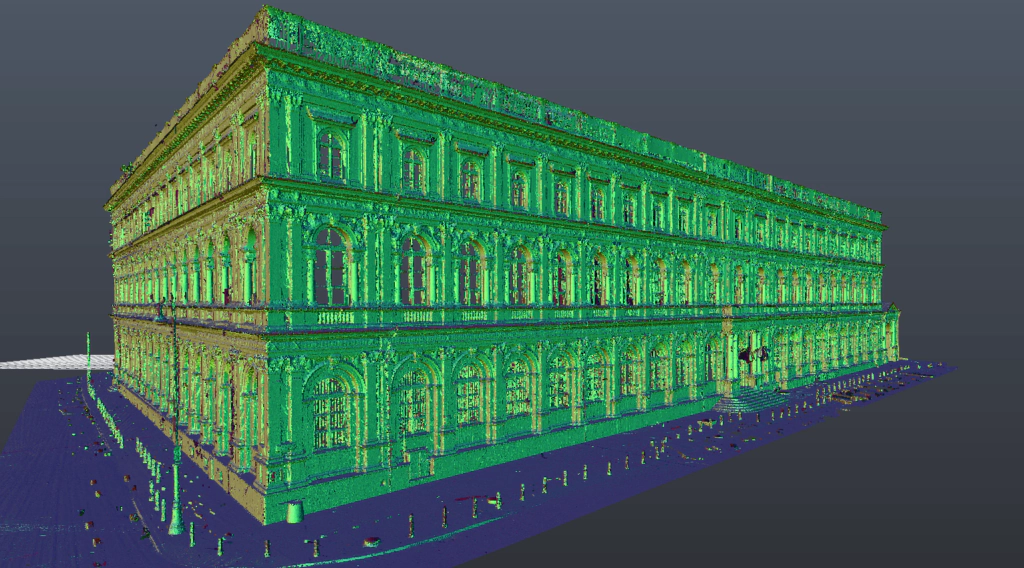
A point cloud to HBIM workflow is one of the most effective ways to develop reliable digital models of historic structures. The point cloud acts as a geometric reference that reflects the actual building rather than an idealized version of it.
This is especially important in heritage projects because:
- structural deformation is common,
- surfaces are often irregular,
- details may vary from one location to another,
- older buildings rarely match modern geometric assumptions,
- decorative and historical features require careful interpretation.
In this workflow, the point cloud does not become the final result by itself. It becomes the measured basis for developing an HBIM model that can support documentation, restoration, and long-term heritage planning.
For projects focused specifically on survey accuracy and digital recording of historic assets, this process is closely connected with 3D Laser Scanning for Architectural Heritage Documentation, where the role of site capture is explored in more detail.
How HBIM Is Used in Practice
The practical use of HBIM in architecture and heritage projects depends on the project type, but several applications appear repeatedly.
Restoration and Conservation Planning
HBIM helps teams understand existing conditions before interventions begin. This improves decision-making for restoration, conservation, and structural repair.
Existing Conditions Documentation
Historic buildings often need accurate documentation before any planning starts. HBIM supports this by combining measured geometry with organized building information.
Renovation and Adaptive Reuse
When a historic building is being adapted for new use, HBIM creates a structured base for design decisions without losing sight of heritage constraints.
Coordination Across Disciplines
HBIM helps architects, engineers, conservation specialists, and stakeholders work from a common digital reference rather than fragmented records.
Long-Term Digital Asset Management
In some projects, the HBIM model continues to be useful after restoration as a digital record for future maintenance, monitoring, and heritage management.
Contact Us Now for a Free Consultation!
Challenges of HBIM for Historic Buildings
Although HBIM is highly valuable, it is not a simple modeling exercise. Historic buildings introduce challenges that are less common in standard BIM projects.
Typical issues include:
- irregular and non-standard geometry,
- incomplete or inconsistent source documentation,
- the need to interpret damaged or altered elements,
- varying levels of detail within one building,
- complex decorative or historic components,
- balancing geometric accuracy with usable model structure,
- coordination between conservation goals and digital modeling logic.
These challenges are one reason why historic building BIM should not be treated as a routine modeling task. It requires survey-based understanding, careful interpretation, and experience in working with existing structures rather than new-build assumptions.
HBIM vs Conventional BIM
The difference between HBIM and conventional BIM is not only the building age. It is also the logic of the workflow.
| Aspect | Conventional BIM | HBIM |
|---|---|---|
| Starting point | Design intent | Existing historic structure |
| Geometry | Usually regular and planned | Often irregular and deformed |
| Source data | Design drawings and specifications | Survey data, point clouds, existing documentation |
| Modeling logic | New construction workflow | Existing-condition and heritage workflow |
| Main purpose | Design, coordination, construction | Documentation, restoration, conservation, reuse |
| Information structure | Standardized project data | Heritage-focused and condition-based information |
This comparison makes it clear that HBIM for historic buildings is not just standard BIM applied to an old building. It is a more specialized workflow built around real conditions and heritage priorities.
Why Accurate Data Capture Is Essential
Without accurate survey data, even the best modeling effort will be limited by assumptions. That is why the quality of the initial capture phase is critical in HBIM work.
Historic buildings often include:
- warped walls,
- uneven floors,
- complex roof shapes,
- decorative detailing,
- hidden changes from previous interventions,
- partial deterioration or damage.
All of this means that reliable geometric input is essential. In practice, that usually requires high-quality capture through 3D laser scanning services and detailed point cloud services before the HBIM model is developed.
Why ScanM2
At ScanM2, we work with reality-capture-based building documentation, point cloud workflows, scan-based BIM processes, and digital modeling for complex existing structures. We understand that HBIM for historic buildings requires more than simply creating a visually accurate model. It requires a structured and usable digital resource that can support conservation, design, coordination, and long-term building understanding.
Our work in this field is supported by broader expertise in BIM modeling services, scan-based documentation, and project workflows that connect measured data to usable digital models. For historic buildings, this means approaching each project with an emphasis on actual building conditions, reliable geometry, and practical digital outputs that serve restoration and heritage goals.
FAQ
What is HBIM?
HBIM stands for Historic Building Information Modeling. It is a BIM-based workflow used to document, model, and manage historic buildings using measured data and structured digital modeling.
How is HBIM different from regular BIM?
Regular BIM usually starts from design intent for new construction, while HBIM starts from the actual condition of an existing historic building and focuses on documentation, restoration, and heritage management.
Why is HBIM useful for historic buildings?
HBIM helps teams document irregular geometry, organize building information, support restoration planning, and create a digital reference for conservation and long-term management.
Does HBIM require laser scanning?
In most cases, accurate HBIM development benefits greatly from high-quality survey data, which is why 3D laser scanning services and point cloud services are commonly used.
What is point cloud to HBIM?
Point cloud to HBIM is the process of converting measured point cloud data into a structured HBIM model for use in documentation, restoration, and heritage workflows.
Can HBIM support renovation and adaptive reuse?
Yes. HBIM is highly useful for renovation, adaptive reuse, and planning interventions in historic buildings because it provides a reliable digital model of the existing structure.

