

When Do You Need 3D Building Scanning in Construction Projects? Use Cases & Benefits
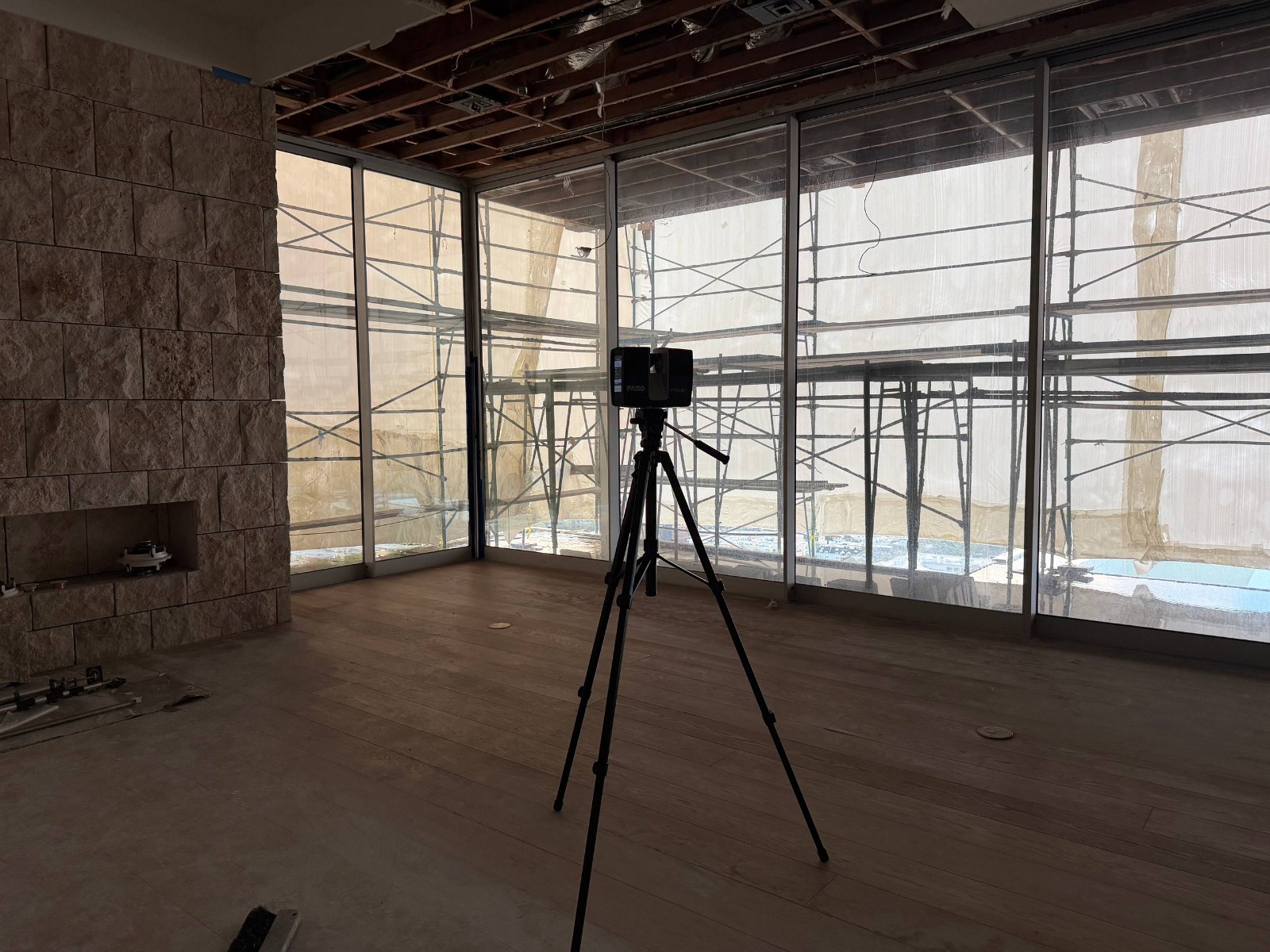

In modern construction, precision is no longer optional. 3D building scanning in construction has become an essential tool for architects, engineers, and contractors who need accurate, real-world data before making critical decisions. From renovation projects to complex MEP coordination, 3D scanning ensures that every design and modification is based on reliable information.
Let’s explore when and why 3D building scanning is necessary in construction projects.
What Is 3D Building Scanning?
3D building scanning is a process that captures the physical dimensions and geometry of a structure using advanced laser measurement technology. Specialized equipment collects millions of spatial data points and generates highly detailed point cloud data, which represents the exact condition of a building.
Professional building scanning services use this data to create accurate digital models and documentation. The result is a precise digital representation of an existing structure that can be used for design, analysis, renovation, or reconstruction.
Unlike traditional measurement methods, 3D scanning captures full spatial context, including walls, ceilings, columns, structural elements, and mechanical systems — all within a single dataset.
When Is Building Scanning Required in Construction?

There are many situations where construction laser scanning becomes critical.
1. When You Need to Scan an Existing Building
Before starting renovation, expansion, or structural changes, teams must scan existing building conditions to understand real dimensions and layouts. An accurate existing condition survey eliminates guesswork and reduces costly errors.
2. Commercial Building Scanning Before Renovation
In large-scale commercial building scanning projects, especially offices, hospitals, shopping centers, or industrial facilities, traditional surveying methods are often too slow or incomplete. Laser scanning captures comprehensive spatial data quickly and with high precision.
3. Construction Site Laser Scanning for Active Projects
On active job sites, construction site laser scanning helps verify progress, compare design intent to real-world conditions, and detect deviations early in the construction process.
3D Laser Scanning for Renovation and Retrofit Projects
Renovation projects and retrofit projects demand exceptional accuracy. Existing buildings often contain undocumented modifications, structural irregularities, or aging infrastructure.
Laser scanning for renovation provides reliable data before planning:
- Structural modifications
- Major layout changes
- Facility upgrades
- Expansion of utilities or systems
Without accurate scanning, renovation teams risk design conflicts, rework, and unexpected delays. High-resolution scan data ensures that engineers can safely design around real structural conditions.
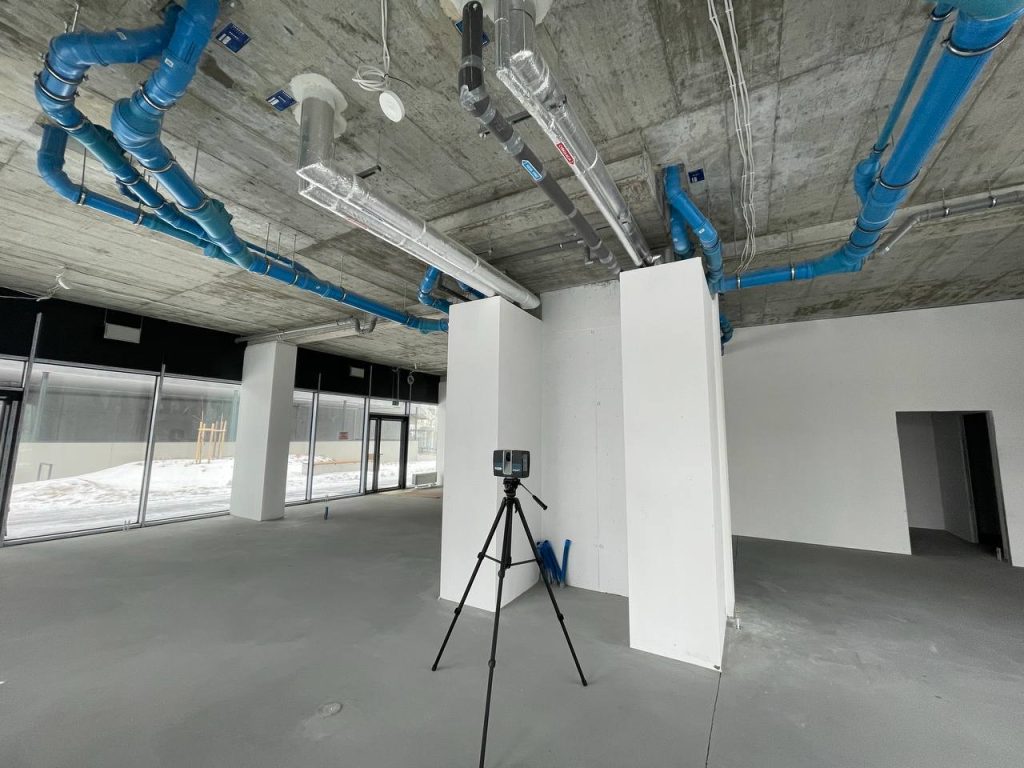
Building Scanning for MEP Coordination and Clash Detection
Modern buildings contain complex mechanical, electrical, and plumbing systems. Accurate geometry is essential for effective MEP coordination.
Using scan data within a scan to BIM workflow allows teams to create precise digital models for:
- Clash detection
- Routing new ductwork and piping
- Installing equipment in tight spaces
- Verifying clearances
With 3D modeling from scans, project teams can detect potential conflicts before installation begins, saving time and preventing costly on-site corrections.
3D Scanning for As-Built Documentation
At the completion stage, as-built documentation becomes critical for facility management, compliance, and future renovations.
Construction documentation scanning ensures accurate records of what was actually built. This includes complete existing condition documentation, reflecting real geometry rather than design assumptions.
These datasets support long-term asset management and help create a reliable digital twin of the building.
When Traditional Measurement Is Not Enough
While manual measurements and traditional surveying methods are still used, they are often insufficient for complex projects.
Situations that require high-accuracy scanning include:
- Buildings with complex geometry
- Large commercial or industrial facilities
- Historic structures
- Tight tolerances and structural integrations
- Projects requiring millimeter accuracy
Comparison: Traditional Surveying vs. 3D Building Scanning
| Criteria | Manual Measurements / Traditional Surveying | 3D Building Scanning in Construction |
| Accuracy | Limited, human-error dependent | Millimeter accuracy |
| Speed | Time-consuming | Rapid data capture |
| Coverage | Selective point measurements | Full spatial capture |
| Complex Geometry | Difficult to measure | Easily captured |
| MEP Coordination | Risk of missed conflicts | Supports clash detection |
| Output | 2D drawings | Point cloud data, scan-to-BIM, 3D modeling from scans |
| Documentation | Basic records | Detailed as-built documentation & digital twin |
As projects become more complex, relying solely on traditional methods increases risk and reduces efficiency.
Choosing Professional Building Scanning Services
Selecting the right building scanning services provider is essential for project success.
Look for:
- An experienced laser scanning provider
- Proven expertise in construction environments
- A structured and transparent scanning workflow
- Understanding of specific construction project requirements
- Ability to deliver scan-to-BIM models and construction-ready documentation
A professional team ensures that the collected data integrates seamlessly into design, coordination, and construction processes.
FAQ
What is 3D building scanning in construction?
3D building scanning in construction is a laser-based process that captures accurate spatial data of existing structures. Using advanced laser measurement technology, millions of data points are collected and converted into point cloud data. This information is then used for design verification, renovation planning, scan-to-BIM workflows, and as-built documentation.
When should you scan an existing building?
You should scan an existing building before starting renovation projects, retrofit projects, structural modifications, or facility upgrades. An accurate existing condition survey helps eliminate guesswork and reduces costly errors during design and construction.
How accurate is construction laser scanning?
Modern construction laser scanning delivers millimeter accuracy. Compared to manual measurements and traditional surveying, high-accuracy scanning captures complete building geometry, including complex structures and MEP systems, with significantly greater precision.
What is scan-to-BIM and why is it important?
Scan-to-BIM is the process of converting point cloud data into intelligent BIM models. It supports MEP coordination, clash detection, and 3D modeling from scans. This workflow improves collaboration between architects, engineers, and contractors and reduces conflicts during construction.
Is 3D laser scanning necessary for renovation projects?
Yes. Laser scanning for renovation is highly recommended because existing buildings often differ from outdated drawings. Accurate scan data supports structural modifications, retrofit projects, and system upgrades by providing reliable real-world geometry.
Conclusion
3D building scanning in construction is no longer just an advanced option — it is a strategic necessity. Whether you are working on renovation projects, retrofit projects, structural modifications, MEP coordination, or as-built documentation, laser scanning provides the accuracy and reliability modern construction demands.
By replacing assumptions with precise point cloud data and detailed digital models, construction teams reduce risk, improve collaboration, and deliver higher-quality results with confidence.

