

Scan to BIM for Oil and Gas Facilities
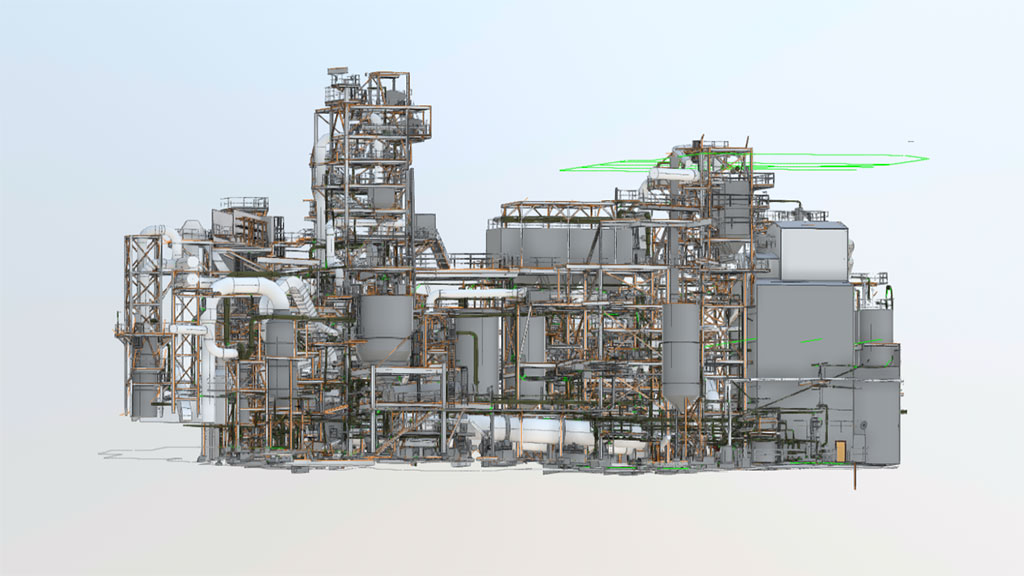
Oil and gas facilities contain complex infrastructure including pipelines, processing units, compressors, and structural platforms. Accurate digital documentation of these environments is essential for modernization projects, engineering coordination, and infrastructure upgrades.
Scan to BIM for oil and gas facilities converts laser scan data into detailed BIM models that represent the real geometry of industrial assets. These models allow engineers to analyze pipeline systems, refinery equipment, and plant infrastructure before implementing upgrades or equipment modifications.
Contact Us Now for a Free Consultation!
Why Oil and Gas Facilities Require Scan to BIM
Oil and gas infrastructure evolves continuously as plants undergo modernization, equipment replacement, and process optimization. Over time, original engineering drawings often become inaccurate due to modifications that were never fully documented.
For large facilities such as refineries or compressor stations, even small inaccuracies in documentation can cause significant engineering issues during retrofit or expansion projects.
A point cloud to BIM for oil and gas facilities workflow addresses this challenge by transforming reality-capture data into structured engineering models. These models provide verified geometry of plant infrastructure, allowing engineers to evaluate spatial relationships between equipment, pipelines, and structural elements before implementing design changes.
Accurate BIM models are especially valuable for:
- refinery modernization programs
- pipeline infrastructure upgrades
- offshore platform retrofits
- installation of new process equipment
- digital documentation of legacy facilities
Engineering Challenges in Oil and Gas Facility Modeling
Oil and gas environments introduce unique engineering challenges that require specialized modeling workflows.
Dense Pipeline Infrastructure
Refineries and gas processing plants contain extensive piping systems transporting hydrocarbons, gases, and process fluids between units. Pipes often run through multi-level pipe racks with minimal spacing between lines.
Accurate scan to BIM pipeline modeling is required to capture pipe routing, valve assemblies, supports, and connections. This allows engineers to verify spatial clearances before installing new equipment or modifying existing systems.
Large Process Equipment
Oil and gas plants rely on heavy industrial equipment including:
- compressors
- separators
- heat exchangers
- distillation columns
These components must be represented in BIM models with correct geometry and positioning to ensure reliable engineering analysis during plant modifications.
Structural Platforms and Pipe Racks
Industrial facilities frequently contain elevated platforms and steel support structures designed to carry heavy equipment and pipeline networks. Modeling these structures is critical when evaluating load paths or designing equipment upgrades.
Hazardous Industrial Environments
Many oil and gas installations operate within hazardous zones governed by strict safety regulations. Engineering models must support planning activities without requiring repeated field measurements in high-risk environments.
Our Scan to BIM Workflow for Oil and Gas Facilities
A structured workflow ensures that scan data is transformed into engineering-grade BIM models suitable for industrial applications.
1. Reality Capture
The process begins with high-precision reality capture using terrestrial laser scanners. These systems collect millions of spatial measurements representing plant infrastructure.
Laser scanning is typically performed across:
- process units
- pipe racks
- equipment platforms
- compressor stations
- storage tank areas
The result is a detailed point cloud dataset representing the facility environment.
2. Point Cloud Processing

Captured scan data is registered and processed to create a unified point cloud model of the facility.
During this stage engineers perform:
- scan alignment and registration
- noise filtering
- dataset optimization
This processed dataset becomes the reference geometry for BIM modeling.
3. BIM Modeling of Plant Infrastructure

Specialized BIM specialists convert point cloud data into parametric engineering models representing key plant components.
This modeling process typically includes:
- pipeline systems and pipe racks
- refinery equipment and vessels
- compressors and pumps
- structural platforms and steel frameworks
Depending on project requirements, models may be developed at LOD 300 or LOD 400.
4. Engineering Verification
All models are validated against the original point cloud to ensure dimensional accuracy. Critical systems such as piping networks and equipment foundations undergo additional verification.
5. Model Delivery
Final BIM models are delivered in formats compatible with engineering platforms such as:
- Autodesk Revit
- IFC models
- CAD-compatible datasets
These models can be integrated into plant engineering workflows and digital asset management systems.
Industrial BIM Models and Digital Plant Infrastructure Project Gallery


Examples of BIM models developed from laser scan data for oil refineries, pipeline infrastructure, and industrial processing facilities.
What Is Modeled in Oil and Gas Scan to BIM Projects
The scope of scan to BIM projects in oil and gas facilities typically includes a wide range of infrastructure components required for engineering planning.
| Plant Component | BIM Modeling Purpose |
|---|---|
| Pipeline systems | Verification of pipe routing and installation clearances |
| Process equipment | Accurate positioning of compressors, reactors, and vessels |
| Structural frameworks | Modeling of steel platforms, supports, and pipe racks |
| Storage tanks | Documentation of tank geometry and surrounding infrastructure |
| Maintenance platforms | Analysis of maintenance access and safety routes |
| Utility systems | Coordination of electrical and mechanical infrastructure |
These components form a coordinated digital representation of the facility that supports engineering analysis and plant modernization planning.
Contact Us Now for a Free Consultation!
Applications of Scan to BIM in Oil and Gas Industry
The adoption of scan-to-BIM workflows in oil and gas facilities continues to grow as companies modernize infrastructure and implement digital engineering strategies.
Refinery Modernization
Refineries often undergo periodic upgrades to improve efficiency or expand production capacity. BIM models generated from scan data allow engineers to evaluate spatial constraints before installing new equipment.
Pipeline Infrastructure Upgrades
Pipeline systems are frequently modified to accommodate new process units or safety improvements. BIM models help engineers analyze pipe routing and prevent clashes during installation.
Offshore Platform Retrofits
Offshore installations have limited space and complex structural layouts. Accurate BIM models provide engineers with reliable geometry for planning modifications without repeated field measurements.
Equipment Replacement Planning
Replacing compressors, pumps, or heat exchangers requires precise alignment with existing piping and foundations. BIM models derived from scans ensure installation planning is based on real facility conditions.
Digital Plant Documentation
Many oil and gas operators are developing digital twins of their facilities. BIM models generated through scan-to-BIM workflows serve as the foundation for these digital environments.
Benefits of Scan to BIM for Oil and Gas Operators
Implementing scan to BIM workflows offers significant operational and engineering advantages for oil and gas companies.
Key benefits include:
- improved engineering accuracy
- reduced retrofit risks
- faster modernization planning
- reliable digital documentation of plant infrastructure
- better coordination between engineering disciplines
By transforming scan data into structured BIM models, oil and gas operators gain a powerful tool for managing complex industrial facilities and supporting long-term infrastructure development.
FAQ
What is scan to BIM for oil and gas facilities?
Scan to BIM for oil and gas facilities is the process of converting laser scan data into detailed BIM models representing plant infrastructure such as pipelines, equipment, and structural platforms.
How accurate are BIM models created from scan data?
Models derived from laser scanning typically achieve millimeter-level accuracy depending on scanning resolution and modeling requirements.
Can scan to BIM capture complex pipeline systems?
Yes. Advanced modeling workflows allow accurate reconstruction of pipe routing, valves, supports, and connections within complex pipeline networks.
When is scan to BIM used in oil and gas projects?
Scan to BIM is commonly used during refinery modernization, equipment replacement projects, offshore platform upgrades, and pipeline infrastructure modifications.
Can BIM models support digital twin development?
Yes. BIM models generated from scan data often serve as the geometric foundation for digital twins used in facility management and operational optimization.

