

Reverse Engineering for Manufacturing Equipment
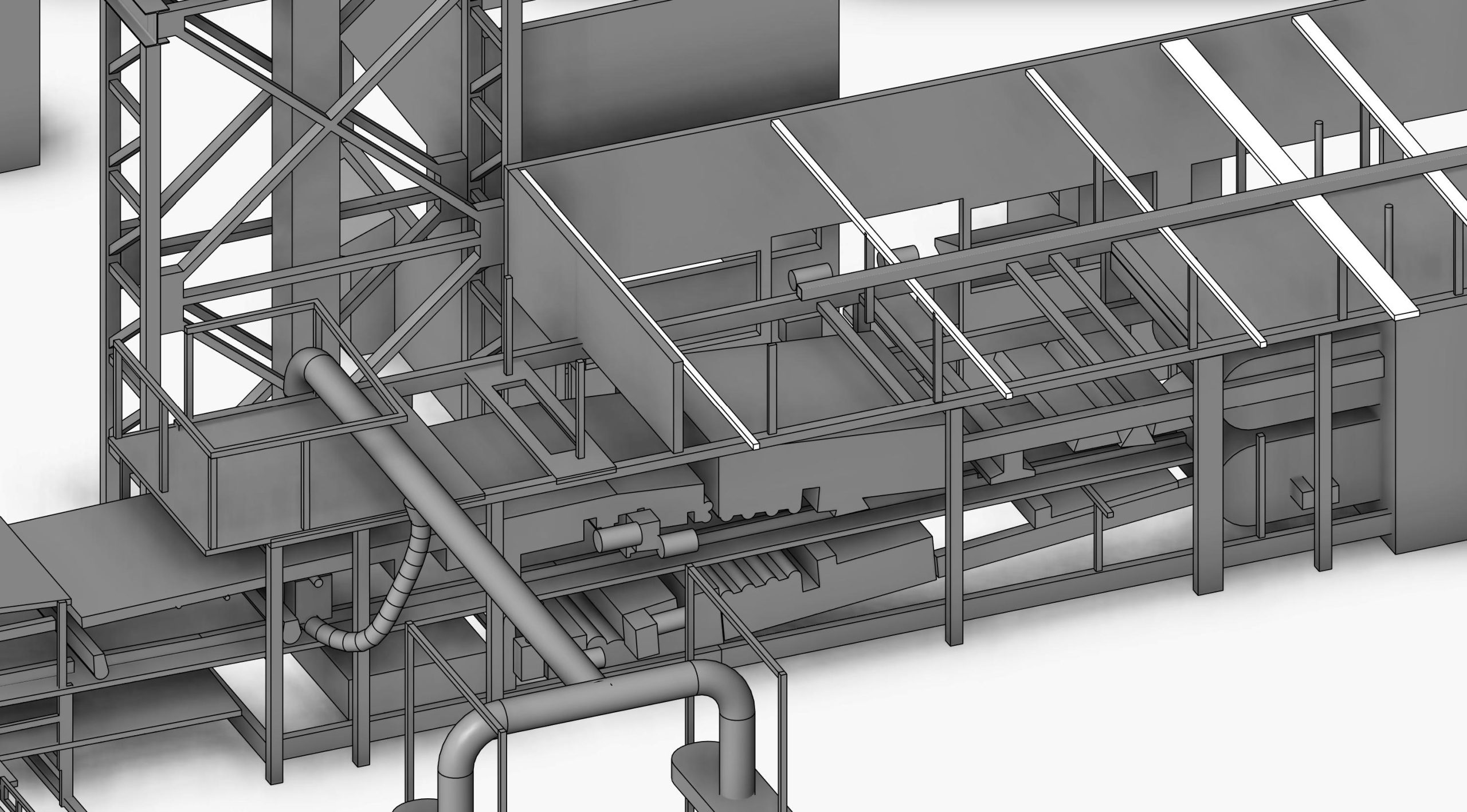
Reverse engineering for manufacturing equipment and industrial machinery is an engineering process used to reconstruct accurate digital models of existing machines, components, and production systems. This service enables industrial companies to restore missing documentation, reproduce obsolete parts, and integrate legacy equipment into modern production environments.
Manufacturing facilities often rely on machinery that has been in operation for decades. In many cases, original CAD models, drawings, or technical specifications are unavailable or outdated. Reverse engineering allows engineers to capture real geometry, analyze functional behavior, and create precise digital representations that reflect actual operating conditions.
Reverse engineering services for manufacturing equipment are widely used by industrial companies, engineering contractors, and plant operators to support modernization, equipment replacement, and production system upgrades. Accurate digital models reduce engineering risks, improve compatibility between legacy and new systems, and ensure reliable integration within existing factory environments.
Contact Us Now for a Free Consultation!
Scope of Reverse Engineering in Manufacturing
Reverse engineering in manufacturing focuses on converting physical machinery into structured digital models that can be used for engineering, production, and integration tasks.
Typical objectives include:
- Creation of accurate 3D CAD models of industrial equipment
- Reconstruction of worn or undocumented components
- Support for equipment modernization and redesign
- Integration of legacy machinery into updated production systems
- Preparation of manufacturing-ready technical documentation
The process combines measurement data, engineering interpretation, and validation against real operating conditions.
Data Acquisition and Geometry Capture
The process begins with capturing the physical geometry of machinery using high-precision 3D Laser Scanning and industrial measurement tools. This produces dense spatial datasets representing complex mechanical assemblies.
Captured elements typically include:
- Machine frames and structural components
- Rotating assemblies and drive systems
- Conveyor and material handling systems
- Interfaces between mechanical and control systems
Point cloud data is then processed, cleaned, and structured to prepare it for accurate engineering reconstruction.
Reverse Engineered Equipment Models


CAD Reconstruction and Digital Modeling
After geometry capture, engineers convert the processed data into parametric CAD models. This stage requires not only geometric reconstruction but also understanding of how the equipment operates under real conditions.
Typical outputs include:
- Parametric 3D models of components and assemblies
- Manufacturing-ready drawings with tolerances
- Assembly models with functional relationships
- Integration-ready formats for engineering systems
Reverse engineering of industrial machinery must account for:
- Shaft alignment and rotational tolerances
- Bearing fits and load distribution
- Thermal expansion in high-temperature environments
- Wear and deformation of components over time
Key Technical Elements in Manufacturing Equipment
1. Transmission and Drive Systems
Industrial machinery often includes complex gear systems and drive assemblies. Accurate reconstruction requires precise modeling of gear geometry, tolerances, and mechanical interactions.
2. Conveyor and Material Handling Systems
Production lines rely on synchronized conveyor systems. Reverse engineering ensures correct alignment, load distribution, and integration with upstream and downstream processes.
3. CNC and Robotic Interfaces
Modern manufacturing environments integrate automated systems. Reverse engineering must capture mounting geometry, connection points, and interface constraints to ensure compatibility.
Component-Level Reverse Engineering
In many projects, the focus is on individual components rather than entire machines. This is common when parts are worn, obsolete, or unavailable.
Typical use cases include:
- Reproduction of mechanical components
- Replacement of discontinued parts
- Redesign for improved performance
- Adaptation for new manufacturing technologies
The workflow typically includes:
- Scanning the component
- Geometry reconstruction
- Creation of parametric CAD model
- Preparation of manufacturing drawings
This approach allows companies to maintain equipment functionality without relying on original suppliers.
Integration with Production Systems
Reverse engineering plays a key role in industrial modernization and production system upgrades.
Applications include:
- Integration of new machinery into existing production lines
- Layout optimization of factory environments
- Clash detection between equipment and infrastructure
- Simulation of machine interaction and material flow
Accurate digital models enable engineers to plan modifications before implementation, reducing downtime and operational risks.
Quality Control and Validation
Engineering accuracy is critical in reverse engineering workflows. All reconstructed models must be validated against real-world conditions.
Validation methods include:
- Deviation analysis between scan data and CAD models
- Verification of tolerances for moving parts
- Functional validation of assemblies
- Assembly fit checks for multi-component systems
These steps ensure that reconstructed components perform reliably in production environments.
Applications Across Manufacturing Industries
Reverse engineering services are used across a wide range of industrial sectors:
- Automotive manufacturing
- Food and beverage production
- Packaging and logistics systems
- Metal fabrication and machining
- Chemical and process industries
Each industry introduces specific constraints that must be considered during reconstruction.
Benefits of Reverse Engineering for Manufacturing Equipment
Reverse engineering provides measurable advantages for industrial companies working with complex machinery.
Restoration of Missing Documentation
Creates accurate models and drawings for equipment without existing data.
Reduced Dependency on OEM Suppliers
Enables independent production of replacement components.
Improved Compatibility Between Systems
Supports integration of legacy and modern equipment.
Extended Equipment Lifecycle
Allows continued operation of machinery without full replacement.
Support for Modernization and Automation
Facilitates upgrades and integration with new technologies.
Reduced Downtime and Operational Risks
Accurate models enable faster repairs and installation planning.
Conclusion
Reverse engineering for manufacturing equipment is a critical engineering service that enables industrial companies to reconstruct, analyze, and optimize machinery within complex production environments. By combining precise data capture with engineering expertise, it supports equipment modernization, reduces operational risks, and ensures long-term reliability of production systems.
FAQ
What is reverse engineering for manufacturing equipment?
It is the process of capturing and reconstructing industrial machinery into accurate digital models for analysis, replication, or modification.
When is reverse engineering required?
It is used when documentation is missing, components are obsolete, or equipment must be upgraded or integrated into new systems.
How accurate are reverse engineered models?
Engineering-grade workflows typically achieve millimeter or sub-millimeter accuracy depending on project requirements.
Can reverse engineering replace original components?
Yes, reconstructed models can be used to manufacture replacement parts compatible with existing systems.
What deliverables are provided?
Typical outputs include CAD models, technical drawings, and structured datasets for engineering use.

