

Point Cloud Processing for Manufacturing Facilities
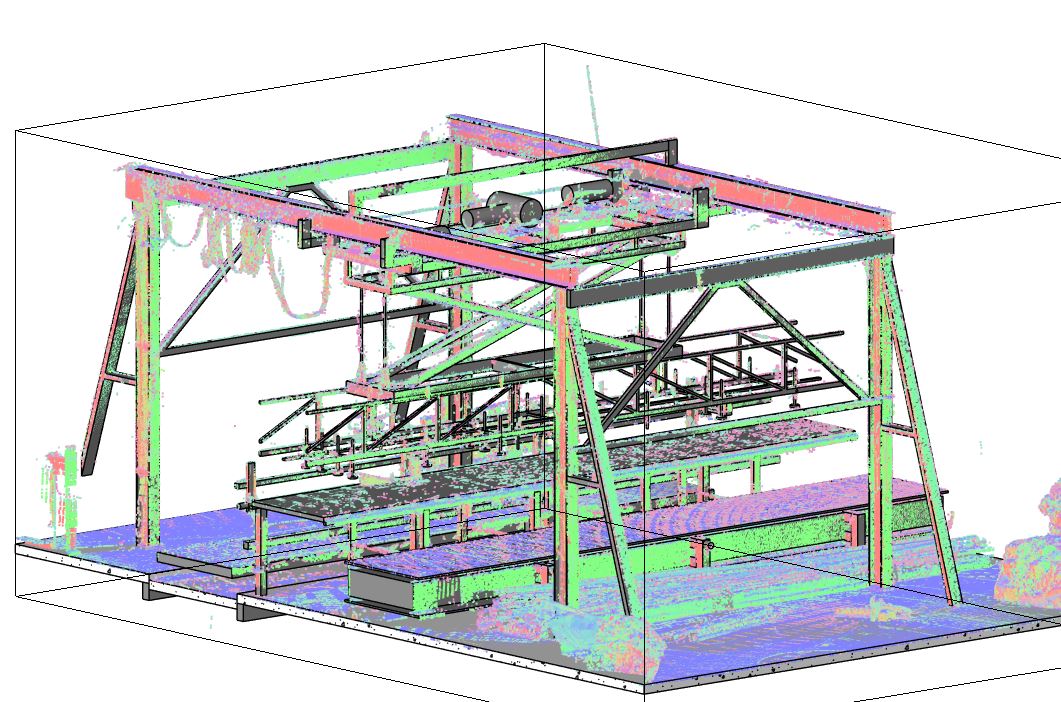
Point cloud processing for manufacturing facilities is a data-driven workflow focused on transforming raw scan datasets into structured, engineering-ready models. Unlike generic building environments, production plants contain dense equipment layouts, dynamic routing systems, and tight tolerances between assets. This requires a specialized approach to point cloud data processing that accounts for mechanical complexity, operational constraints, and spatial interdependencies.
The primary objective is not visualization, but the creation of reliable spatial datasets that can support engineering decisions, retrofits, and operational planning. High-density scans from factories must be filtered, segmented, and structured into usable geometric and semantic representations aligned with real production conditions.
Point cloud processing services for manufacturing facilities are widely used by engineering companies, industrial operators, and contractors to prepare accurate spatial data for design, reconstruction, and modernization projects. Structured datasets improve coordination between disciplines, reduce engineering risks, and enable efficient planning of complex industrial environments.
Contact Us Now for a Free Consultation!
Industry-Specific Challenges
Manufacturing environments introduce several technical challenges that directly impact point cloud processing workflows:
- High equipment density: CNC machines, conveyor systems, robotic cells, and utility lines are often installed with minimal clearance.
- Non-uniform geometry: Unlike standard buildings, production plants include irregular mechanical assemblies and custom installations.
- Operational constraints: Facilities are rarely fully shut down during scanning, resulting in occlusions, noise, and incomplete datasets.
- Frequent modifications: Equipment upgrades and layout changes require continuous data updates and reprocessing.
These factors make factory point cloud processing fundamentally different from standard architectural applications.
Data Acquisition Context
Point cloud data in manufacturing facilities is typically generated using high-precision terrestrial laser scanning. The resulting datasets include billions of points representing:
- Production lines and conveyor systems
- Structural elements (columns, beams, floors)
- Mechanical equipment (presses, turbines, CNC machines)
- Utility networks (piping, cable trays, HVAC ducts)
At this stage, integration with 3D Laser Scanning and Scan to BIM workflows is critical to ensure consistency between raw data capture and downstream processing.
Core Processing Workflow

1. Data Registration and Alignment
Multiple scans are aligned into a unified coordinate system. In manufacturing plants, this step must account for:
- Long production lines requiring extended scan chains
- Repetitive geometry (e.g., identical machines) that complicates alignment
- Limited reference points due to equipment obstruction
Accurate registration ensures spatial integrity across the entire facility.
2. Noise Reduction and Data Cleaning
Raw datasets often include noise caused by:
- Moving machinery
- Reflective metal surfaces
- Dust and environmental interference
Filtering algorithms are applied to remove outliers without compromising critical geometric details. This is especially important for precision equipment where millimeter-level accuracy is required.
3. Segmentation of Industrial Assets
Unlike generic point cloud processing, manufacturing facilities require detailed segmentation of:
- Conveyor systems
- Robotic arms
- Pipe networks and cable trays
- Structural frameworks
This step enables targeted modeling and simplifies downstream engineering workflows.
4. Feature Extraction and Modeling
Key geometric features are extracted to build structured representations:
- Cylindrical detection for piping systems
- Planar recognition for walls, floors, and platforms
- Parametric extraction of equipment envelopes
Processed datasets are then converted into engineering-ready outputs through BIM Modeling or used in Reverse Engineering for Manufacturing Equipment workflows.
Technical Elements Specific to Manufacturing
Point cloud processing in production environments involves several industry-specific components:
- Conveyor system alignment modeling: Ensuring accurate representation of continuous transport lines across large distances
- Machine envelope reconstruction: Defining operational boundaries of CNC machines and robotic cells
- Piping network topology extraction: Identifying complex routing systems with multiple elevation levels
These elements are critical for layout optimization, clash detection, and future equipment integration.
Applications
Production Line Optimization
Processed point cloud data enables accurate analysis of existing layouts. Engineers can identify bottlenecks, inefficient routing, and spatial conflicts.
Equipment Retrofit and Upgrade
When introducing new machinery, precise spatial data is required to validate installation feasibility without disrupting operations.
Digital Reconstruction of Legacy Facilities
Older plants often lack reliable documentation. Point cloud modeling provides a complete digital representation of the facility, enabling modernization projects.
Safety and Compliance
Accurate spatial datasets help evaluate clearance zones, emergency access paths, and compliance with industrial safety standards.
These applications make industrial point cloud processing an essential service for companies managing complex manufacturing facilities and production environments.
As-Built Documentation
Processed point clouds serve as the foundation for As-Built Drawings for Manufacturing Facilities. These drawings reflect actual site conditions rather than outdated design documentation.
Key outputs include:
- Updated floor plans with equipment layouts
- Section drawings showing vertical clearances
- Detailed representations of utility systems
This documentation is essential for maintenance planning, audits, and facility management.
Data Structuring and Output Formats
Processed datasets are delivered in formats suitable for engineering workflows:
- Structured point clouds (segmented and classified)
- 3D models of equipment and infrastructure
- CAD-compatible geometry for integration into existing systems
- BIM-ready datasets for lifecycle management
The goal is to ensure interoperability across design, engineering, and operations teams.
Integration with Engineering Workflows
Point cloud processing is not an isolated service. It integrates directly with:
- Layout planning tools
- Digital twin platforms
- Maintenance management systems
- Simulation environments for production optimization
This integration enables continuous use of spatial data beyond initial processing.
Quality Control
Quality assurance in industrial point cloud processing includes:
- Verification of geometric accuracy against control points
- Cross-checking alignment across scan zones
- Validation of extracted features (pipes, equipment, structures)
Given the operational impact of errors in manufacturing environments, quality control is a critical stage of the workflow.
Benefits of Point Cloud Processing for Manufacturing Facilities
- Point cloud processing provides measurable advantages for industrial companies working with complex production environments.
- Accurate Spatial Data for Engineering Decisions
Structured datasets reflect real facility conditions, enabling precise planning and design. - Reduced Risk During Equipment Installation and modernization
Validated geometry minimizes clashes, misalignment, and integration errors. - Improved Coordination Between Engineering Disciplines
Mechanical, structural, and process engineers work with consistent data. - Faster Planning of Industrial Projects
Engineers can quickly analyze layouts and prepare design solutions. - Reliable Documentation of Existing Conditions
Processed datasets serve as a foundation for as-built drawings and BIM models. - Enhanced Efficiency of Industrial Workflows
Accurate spatial data improves planning, reduces rework, and supports long-term facility management.
Conclusion
Point cloud processing for manufacturing facilities is a critical engineering service that transforms raw scan data into structured, reliable datasets used across industrial workflows. By enabling accurate modeling, documentation, and analysis, it supports modernization, reduces risks, and improves decision-making in complex production environments.
Unlike generic workflows, factory point cloud processing requires a deep understanding of production systems, mechanical layouts, and infrastructure dependencies. The result is a reliable digital foundation for optimizing and maintaining modern manufacturing facilities.

