

Digital Twin and 3D Scanning for Modern Data Centers in the USA
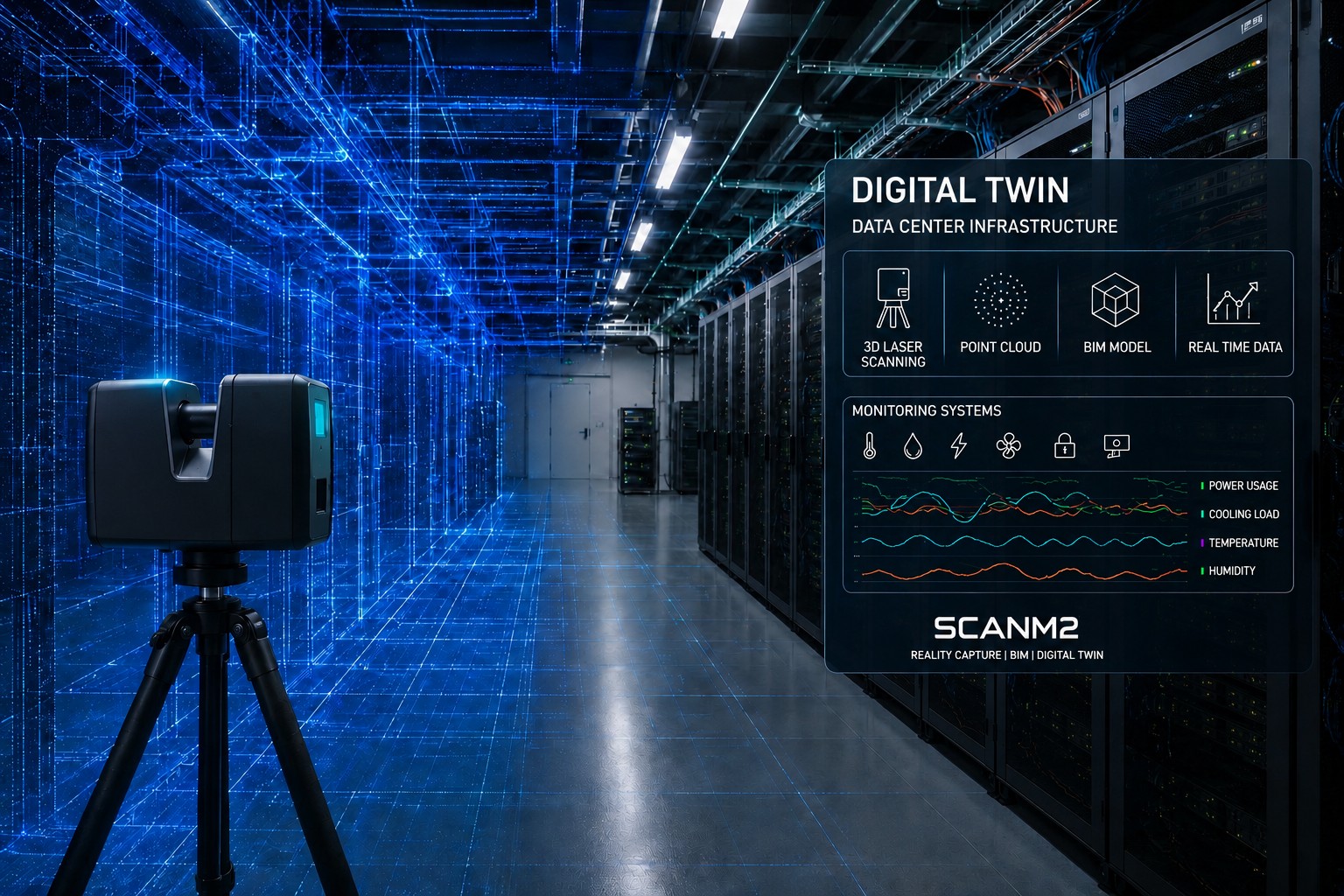
Why Modern Data Centers Require Accurate Digital Infrastructure
Modern data centers are becoming the foundation of the digital economy and critical infrastructure for cloud services, AI platforms, enterprise systems, and large-scale data storage. The U.S. data center market continues to grow rapidly as investments in hyperscale facilities, AI infrastructure, and mission critical environments increase across regions such as Dallas, Austin, New York, Silicon Valley, Chicago, Phoenix, Miami, Los Angeles, and Seattle.
As infrastructure complexity grows, operators must manage thousands of interconnected engineering components including server rooms, cooling systems, electrical networks, cable infrastructure, monitoring systems, sensors, and security platforms. In these environments, even small documentation errors may create serious operational and coordination risks.
This is why technologies such as Data Center Digital Twin, 3D Laser Scanning Data Centers, and Reality Capture for Data Centers are becoming increasingly important for infrastructure planning, modernization, and facility management.
Digital Infrastructure for Modern Data Centers
ScanM2 specializes in high-precision 3D laser scanning, reality capture, BIM modeling, and Digital Twin workflows for modern data center infrastructure and mission critical facilities.
We help operators, developers, and engineering teams create accurate digital environments for server rooms, MEP systems, cooling infrastructure, electrical networks, and facility management workflows. Using laser scanning and point cloud technologies, we prepare accurate digital documentation and BIM-ready datasets for modernization, expansion, and operational management.
Our team works with international projects across the USA, Europe, the UAE, and other regions, supporting both new construction and existing data center modernization projects.
Contact Us Now for a Free Consultation!
How 3D Laser Scanning Works in Data Centers
Modern data center facilities contain extremely dense engineering infrastructure that is difficult to document using traditional measurement methods. Manual surveying often cannot provide the speed, accuracy, or coverage required for complex server environments and mission critical systems.
Using 3D Laser Scanning Data Centers workflows, specialists capture millions of precise measurement points throughout the facility. The resulting point cloud creates an accurate digital representation of:
- server rooms
- cable infrastructure
- cooling systems
- electrical equipment
- MEP networks
- technical spaces
- structural geometry
This process is commonly used for:
- server room scanning
- MEP scanning
- existing conditions documentation
- facility modernization
- engineering verification
- infrastructure expansion planning
For mission critical facilities, accurate scan data helps reduce risks during reconstruction and minimizes uncertainty before engineering work begins.
Digital Twin Technology for Data Centers

A modern Data Center Digital Twin is more than a visual 3D model. It is a coordinated digital environment that combines geometry, engineering systems, BIM data, operational information, and live monitoring systems.
Digital twin infrastructure may integrate:
- BIM models
- IoT devices
- SCADA systems
- monitoring platforms
- live operational data
- facility management systems
- digital asset management platforms
This allows operators to monitor infrastructure conditions in real time while maintaining accurate spatial and engineering documentation.
Digital twin technologies are increasingly used across major U.S. data center markets such as Dallas, Silicon Valley, Chicago, New York, and Northern Virginia to support:
- infrastructure planning
- operational management
- cooling optimization
- engineering coordination
- predictive maintenance
- future expansion projects
Point Cloud to BIM for Mission Critical Facilities
After laser scanning is completed, the captured point cloud can be converted into a BIM environment using Point Cloud to BIM USA workflows.
This process allows engineering teams to create coordinated digital models of:
- architectural systems
- structural components
- server infrastructure
- cooling systems
- cable management
- electrical and mechanical networks
The BIM environment becomes a reliable digital foundation for modernization, coordination, and long-term facility management.
| Workflow Stage | Result |
|---|---|
| Laser scanning | Raw site geometry |
| Point cloud registration | Coordinated scan dataset |
| BIM modeling | Structured digital model |
| Data integration | Digital Twin environment |
| Facility management | Operational infrastructure model |
For mission critical facilities, this workflow significantly improves project coordination and reduces conflicts during reconstruction and expansion projects.
Data Center Modernization and Infrastructure Expansion
Many existing U.S. data centers are currently undergoing modernization driven by:
- AI infrastructure growth
- increased server density
- cloud computing expansion
- higher cooling demands
- infrastructure optimization requirements
Older facilities often face serious documentation challenges:
- outdated drawings
- undocumented modifications
- missing engineering data
- overloaded MEP systems
- inefficient infrastructure layouts
Using Reality Capture for Data Centers and High Precision Laser Scanning, operators can create accurate existing conditions documentation before modernization begins.
This supports:
- safer reconstruction workflows
- infrastructure upgrades
- cooling system replacement
- power system expansion
- cable routing redesign
- retrofit planning
Accurate digital documentation is especially important in facilities where downtime risks must be minimized.
Key U.S. Markets for Data Center Digitalization
Several regions in the United States have become major hubs for data center infrastructure and digital twin implementation.
Dallas and Austin
Texas continues to attract large-scale investment due to energy availability, infrastructure growth, and hyperscale expansion. Data Center Dallas and Data Center Austin projects increasingly require BIM coordination and digital infrastructure management.
Silicon Valley and San Francisco
The concentration of AI companies and cloud technology providers drives demand for Digital Twin Silicon Valley workflows and advanced infrastructure digitization.
New York and Chicago
High-density urban infrastructure and financial-sector requirements make Data Center Scanning New York and Reality Capture Chicago workflows especially important for modernization and operational reliability.
Phoenix and Miami
Rapid cloud infrastructure growth creates increasing demand for laser scanning, facility management BIM, and digital asset management solutions.
Los Angeles and Houston
Large engineering environments and industrial-scale infrastructure support growing adoption of Laser Scanning Los Angeles and Digital Twin Houston technologies.
BIM, IoT, and Live Data Integration
One of the major advantages of modern digital twin environments is the integration of real-time operational data with accurate building geometry.
This may include:
- environmental monitoring
- cooling system analytics
- energy consumption
- sensor data
- security systems
- operational dashboards
- facility performance metrics
Combining Facility Management BIM, IoT systems, and live monitoring platforms helps operators improve infrastructure transparency and respond faster to operational risks.
For hyperscale facilities and AI-driven infrastructure, this level of digital integration is becoming increasingly important.
Why Accurate Digital Documentation Matters
Data centers operate under extremely strict reliability requirements. In these environments, inaccurate documentation can lead to:
- engineering conflicts
- construction delays
- operational disruptions
- maintenance risks
- coordination errors
Accurate digital infrastructure supports:
- safer modernization workflows
- reliable engineering coordination
- improved facility management
- long-term scalability
- efficient digital asset management
- better operational transparency
Because of this, many operators are moving away from fragmented documentation and adopting centralized Digital Twin environments supported by laser scanning and BIM technologies.
Conclusion
The rapid growth of AI infrastructure, cloud computing, and hyperscale facilities is transforming how data centers are designed, documented, and managed across the United States.
Technologies such as Data Center Digital Twin, 3D Laser Scanning Data Centers, Point Cloud to BIM USA, and Reality Capture for Data Centers help operators create more accurate, coordinated, and scalable infrastructure environments.
From server room scanning and MEP documentation to BIM integration and live operational monitoring, digital twin workflows provide a reliable foundation for modernization, facility management, and future infrastructure expansion.
For mission critical facilities where operational continuity and engineering precision are essential, accurate digital infrastructure has become a strategic requirement rather than an optional technology.
Ready to Digitize Your Data Center Infrastructure?
ScanM2 supports data center owners, developers, engineering companies, and facility operators with high-precision digital documentation and Digital Twin workflows for mission critical infrastructure.
Using 3D laser scanning, reality capture, point cloud processing, and BIM modeling, we support data center construction, modernization, retrofit, and facility management projects across the USA, UAE, Europe, and other regions.
Contact ScanM2 to discuss your data center scanning, BIM, or Digital Twin project.

