
Laser Scanning During Live Data Center Operations: How to Capture Reality Without Downtime

Why Data Centers Cannot Afford Downtime
Modern data centers operate as mission-critical facilities where downtime is not an option. Cloud platforms, enterprise systems, AI infrastructure, financial services, and large-scale digital applications depend on continuous availability.
At the same time, data centers are constantly changing. Operators expand capacity, replace equipment, upgrade cooling systems, reorganize cable routes, and modernize electrical infrastructure. These changes require accurate information about existing conditions.
The challenge is simple: how can teams capture the real geometry of a live data center without interrupting operations?
This is where 3D laser scanning becomes especially valuable. It allows project teams to document existing infrastructure quickly, accurately, and without physical contact with sensitive equipment.
Why Existing Documentation Is Often Outdated
Many data centers are modified many times during their lifecycle. Server racks are added, cable trays are extended, cooling systems are changed, and technical rooms are reconfigured.
As a result, original drawings often no longer match actual site conditions.
Common documentation problems include:
- outdated floor plans;
- missing cable tray information;
- undocumented MEP changes;
- inaccurate rack layouts;
- incomplete equipment records;
- outdated as-built documentation;
- missing ceiling and raised floor data.
For this reason, many operators rely on Digital Twin and 3D Scanning for Modern Data Centers in the USA to obtain accurate existing conditions before planning upgrades, expansion, or digital infrastructure modernization.
Can Laser Scanning Be Performed While the Data Center Is Operating?
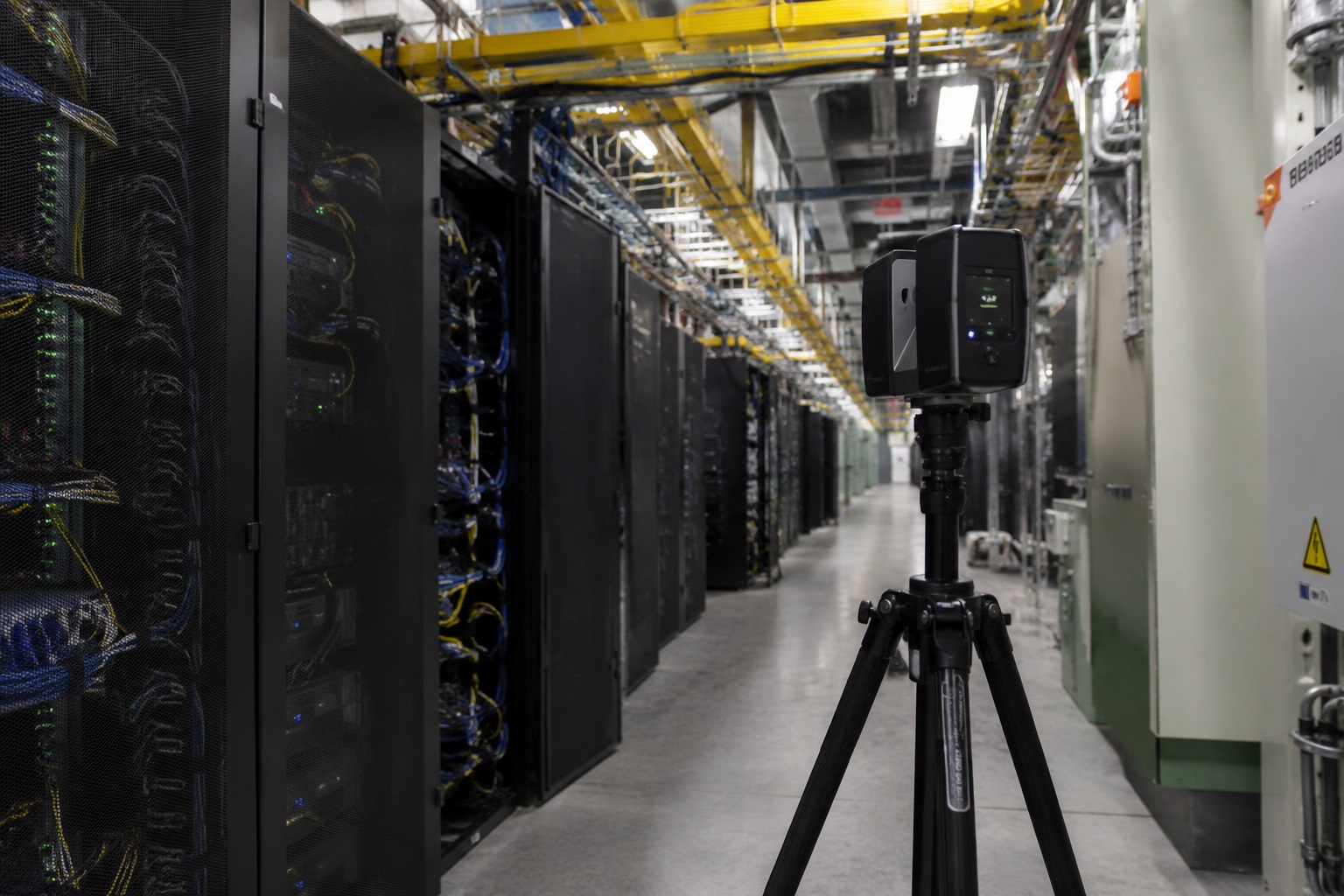
Yes. Laser scanning can be performed in active data centers without shutting down servers or interrupting facility operations.
The process is non-contact and does not require physical interaction with racks, cooling equipment, electrical systems, or IT infrastructure.
Laser scanning can capture:
- room geometry;
- rack locations;
- cable trays;
- ceiling zones;
- MEP systems;
- raised floor areas;
- electrical rooms;
- cooling infrastructure.
The scanner is placed at multiple positions throughout the facility and captures spatial data from a safe distance. This makes it suitable for sensitive environments where minimal disruption is required.
Challenges of Scanning Live Server Rooms
Scanning an operational data center requires careful planning. These facilities often include restricted access zones, dense infrastructure, active equipment, and strict operational procedures.
Common challenges include:
- narrow aisles between racks;
- dense cable management systems;
- limited access to secure rooms;
- raised floors and overhead infrastructure;
- cooling airflow requirements;
- active personnel movement;
- security restrictions;
- sensitive equipment areas.
A successful scanning project must be coordinated with facility managers, security teams, and technical staff before fieldwork begins.
What Is Captured During Data Center Scanning

The scope of scanning depends on project requirements, but a typical data center survey may capture both architectural and engineering elements.
Common scan targets include:
- server rooms;
- rack layouts;
- structural elements;
- walls and partitions;
- raised floors;
- ceiling grids;
- cable trays;
- ductwork;
- piping;
- cooling units;
- electrical panels;
- technical corridors;
- plant rooms.
The goal is not just to create a visual record, but to provide accurate spatial data that can support planning, design, coordination, and facility management.
Deliverables from Data Center Laser Scanning
After scanning, the captured data can be processed into several types of deliverables.
Typical outputs include:
- registered point clouds;
- existing conditions documentation;
- floor plans;
- sections;
- elevations;
- BIM models;
- Revit models;
- IFC models;
- as-built documentation;
- Digital Twin-ready datasets.
For many projects, Point Cloud Services are the first step after scanning. The point cloud must be registered, cleaned, checked, and prepared before it can be used for CAD, BIM, or Digital Twin workflows.
How Scan-to-BIM Supports Data Center Modernization

For complex modernization projects, raw scan data is often converted into a structured BIM model.
Professional Scan to BIM Services help transform measured data into useful digital models that support:
- renovation planning;
- infrastructure upgrades;
- MEP coordination;
- equipment replacement;
- cable tray planning;
- cooling system modifications;
- clash detection;
- facility management.
A BIM model created from scan data allows project teams to work with verified conditions instead of assumptions.
This is especially important in active data centers where mistakes can create operational risk.
Why BIM Matters for Mission-Critical Facilities
Data centers are not simple buildings. They are highly coordinated technical environments where architecture, structure, electrical systems, cooling, security, and IT infrastructure must function together.
Professional BIM Modeling Services help organize this complexity into a usable digital environment.
BIM models can support:
- design coordination;
- MEP planning;
- asset documentation;
- maintenance planning;
- future expansion;
- Digital Twin development;
- operational decision-making.
For mission-critical facilities, BIM provides a more reliable foundation than isolated drawings or outdated documentation.
Best Practices for Scanning Operational Data Centers
Scanning a live data center requires a controlled workflow.
Best practices include:
- coordinate access with facility managers;
- define restricted areas before scanning;
- schedule work around operational requirements;
- minimize personnel movement during scanning;
- avoid interference with cooling airflow;
- define required deliverables in advance;
- confirm LOD requirements before BIM modeling;
- protect sensitive operational information;
- validate scan coverage before leaving the site.
The more carefully the project is planned, the more useful the final data will be.
Why Laser Scanning Reduces Risk During Data Center Upgrades
Upgrades in active data centers often involve tight spaces, complex MEP systems, and strict uptime requirements.
Accurate scan data helps reduce risk by:
- identifying spatial constraints early;
- confirming equipment positions;
- reducing field measurement errors;
- improving coordination between disciplines;
- supporting safer installation planning;
- minimizing unexpected conflicts during construction.
Instead of discovering problems during implementation, teams can detect many issues during planning and design.
From Live Facility Scanning to Digital Twin
Laser scanning is often the first step toward creating a Digital Twin for a data center.
The workflow may include:
- Field scanning of the active facility;
- Point cloud registration;
- Existing conditions documentation;
- BIM modeling;
- Asset data integration;
- Digital Twin development.
Once the geometry and infrastructure are documented, the model can become a foundation for operational data, asset management, maintenance planning, and long-term facility optimization.
Conclusion
Laser scanning makes it possible to capture accurate data inside operational data centers without stopping critical systems.
For live server rooms and mission-critical facilities, this approach helps operators modernize infrastructure, plan upgrades, improve documentation, and prepare BIM or Digital Twin environments with much lower risk.
By combining laser scanning, point cloud processing, Scan-to-BIM workflows, BIM modeling, and Digital Twin development, data center teams can make better decisions based on verified existing conditions.
Need to Scan an Operational Data Center?
ScanM2 provides 3D laser scanning, point cloud processing, Scan-to-BIM, BIM modeling, and Digital Twin documentation for data centers and mission-critical facilities.
We help owners, operators, engineers, and consultants capture accurate existing conditions without disrupting live operations.
Contact ScanM2 to discuss your data center scanning or Digital Twin project.
FAQ
Can laser scanning be performed in an active data center?
Does laser scanning require server shutdown?
What can be captured during data center scanning?
What deliverables can be created after scanning?
Why is scanning useful before data center modernization?
Can scan data be used for Digital Twin development?

ScanM2 Launches ScanTrack: Manage Tasks Directly in a 3D Virtual Tour
18.10.2026
How integrating as-built documentation using advanced 3D scanning and laser scanning technology can revolutionize your real estate marketing strategy. Learn the benefits for agents and ...

Which 3D Laser Scanner Should Architects Choose, and When Is Outsourcing Better?
17.10.2026
How integrating as-built documentation using advanced 3D scanning and laser scanning technology can revolutionize your real estate marketing strategy. Learn the benefits for agents and ...

INTERGEO: How Laser Scanning Is Becoming a Foundation for Management and Decision-Making
24.09.2026
ScanM2 once again took part in INTERGEO, which was held in Munich this year. For us, the event is an opportunity to meet with partners, ...

How 3D Laser Scanning Measures Floor Flatness and Levelness
22.09.2026
Floor flatness and levelness can directly affect equipment installation, racking systems, automated material handling, production lines, flooring systems, and other construction activities that depend on ...

