

Point Cloud Processing for Chemical Manufacturing Facilities
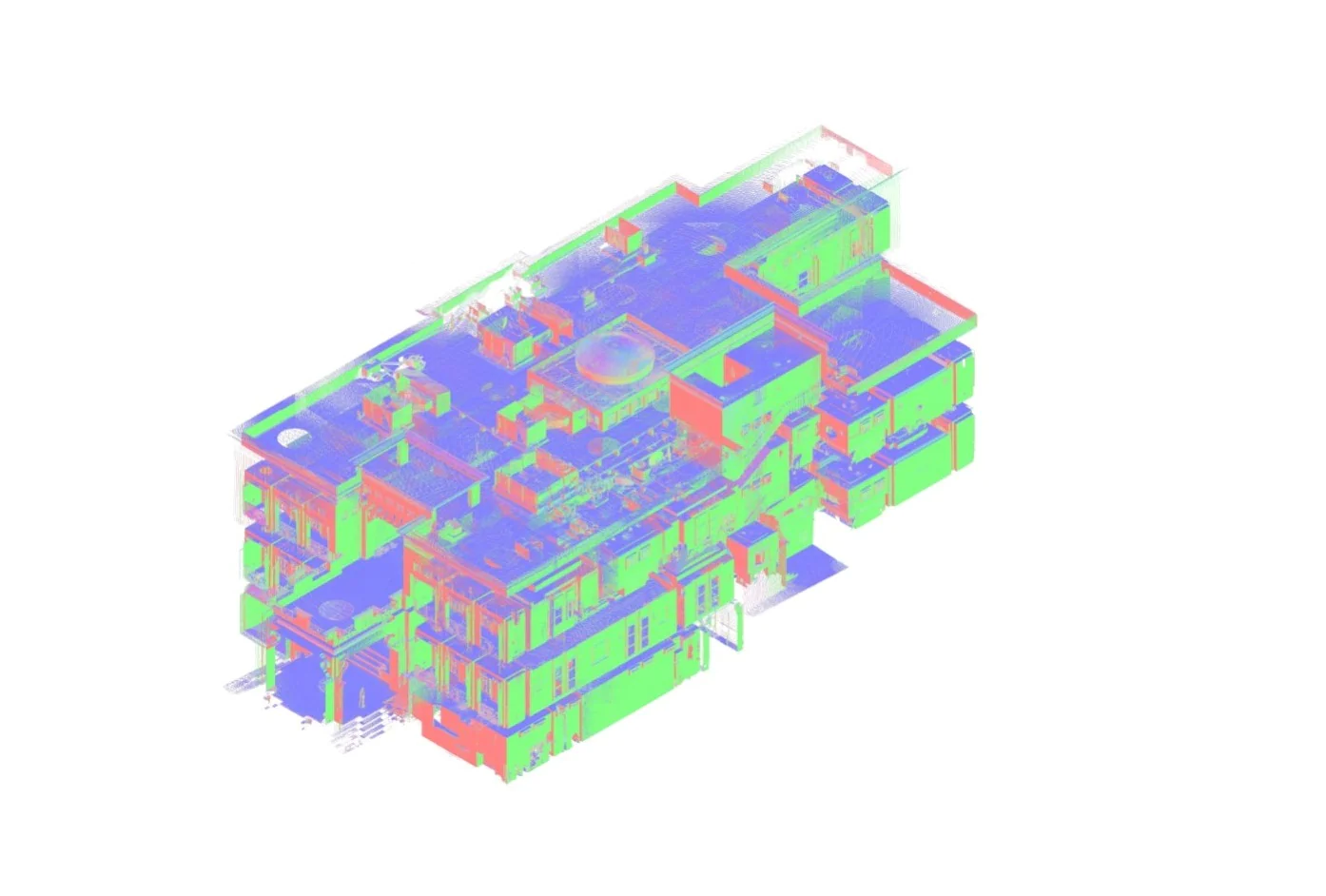
Chemical manufacturing plants contain dense process infrastructure where piping systems, pressure vessels, distillation columns, and instrumentation are installed within compact structural layouts. Accurate spatial documentation of these environments is essential for maintenance planning, plant upgrades, safety analysis, and engineering modifications.
Laser scanning technologies generate detailed spatial datasets that capture the geometry of existing facilities with millimeter accuracy. However, raw scan data requires significant processing before it becomes usable for engineering applications. This is where point cloud processing for chemical plants becomes critical.
Professional processing converts raw laser scan datasets into structured and reliable engineering information. Through registration, filtering, segmentation, and modeling workflows, plant operators and engineering teams gain accurate digital representations of their facilities.
Contact Us Now for a Free Consultation!
Our point cloud processing services for chemical plants support engineering firms, EPC contractors, and plant operators working on revamp projects, equipment retrofits, and digital documentation of operating chemical facilities.
We also support workflows connected with 3D Laser Scanning, point cloud analysis, and scan-to-BIM conversion to ensure seamless integration with engineering and design platforms.
Why Chemical Plants Generate Large Point Cloud Datasets
Chemical plants often include thousands of components installed within interconnected process units. Laser scanning campaigns capture all structural and mechanical elements within these facilities, generating extremely dense datasets.
A typical scan project in a chemical facility may include:
- multiple process units
- pipe racks
- reactor zones
- distillation towers
- storage tank farms
- pump stations
- utility corridors
Each scan position can produce millions of spatial points. When hundreds of scans are combined across the site, datasets can reach billions of points.
For this reason, chemical plant point cloud processing is necessary to organize, optimize, and structure the raw scan data.
Large datasets typically include geometry of:
- process piping systems
- pressure vessels and reactors
- distillation columns
- heat exchangers
- pipe supports and racks
- structural steel platforms
- instrumentation and valve assemblies
Without proper industrial point cloud processing for chemical plants, these datasets remain too heavy and unstructured for engineering use.
Processing workflows allow engineers to navigate, analyze, and extract information from scan data while maintaining high geometric accuracy.
Challenges in Processing Chemical Plant Laser Scan Data
Chemical facilities present several technical challenges when processing laser scanning data. Unlike simpler industrial environments, process plants contain overlapping mechanical systems and complex surface properties.
Dense Piping Networks
Chemical plants contain highly concentrated piping systems that transport fluids between reactors, separators, storage tanks, and utility systems.
These piping networks include:
- process pipelines
- steam lines
- cooling water lines
- chemical transfer lines
- safety relief systems
Thousands of pipes may run parallel within pipe racks or process modules. During point cloud modeling of piping systems, accurate segmentation and filtering are required to distinguish pipes, supports, and adjacent equipment.
Advanced point cloud segmentation in industrial plants is used to isolate piping clusters and prepare them for engineering modeling.
Reflective Surfaces
Many components within chemical facilities are constructed from stainless steel, polished alloys, or insulated metal cladding.
These materials can create scanning artifacts such as:
- reflected laser signals
- noise clusters
- irregular point density
Effective point cloud cleaning and filtering is necessary to remove these distortions and maintain accurate geometry representation.
Filtering workflows identify and remove stray points while preserving critical equipment geometry.
Complex Equipment Geometry
Chemical plants include equipment with complex shapes that are difficult to interpret directly from raw point clouds.
Examples include:
- distillation columns with tray systems
- catalytic reactors
- heat exchangers with multiple connection points
- mixing vessels and agitators
- pressure vessels with reinforcement structures
Precise laser scan data processing for chemical plants ensures these components are accurately captured and separated from surrounding infrastructure.
This enables downstream engineering tasks such as equipment replacement studies or tie-in planning.
Our Point Cloud Processing Workflow for Chemical Facilities
Our industrial point cloud data processing services follow a structured workflow designed specifically for process plants.
1. Data Import and Quality Verification
Raw laser scan datasets from terrestrial scanners are imported and inspected. During this stage we verify:
- scan completeness
- point density
- coordinate consistency
- presence of scanning artifacts
This step ensures the data can support reliable engineering outputs.
2. Point Cloud Registration
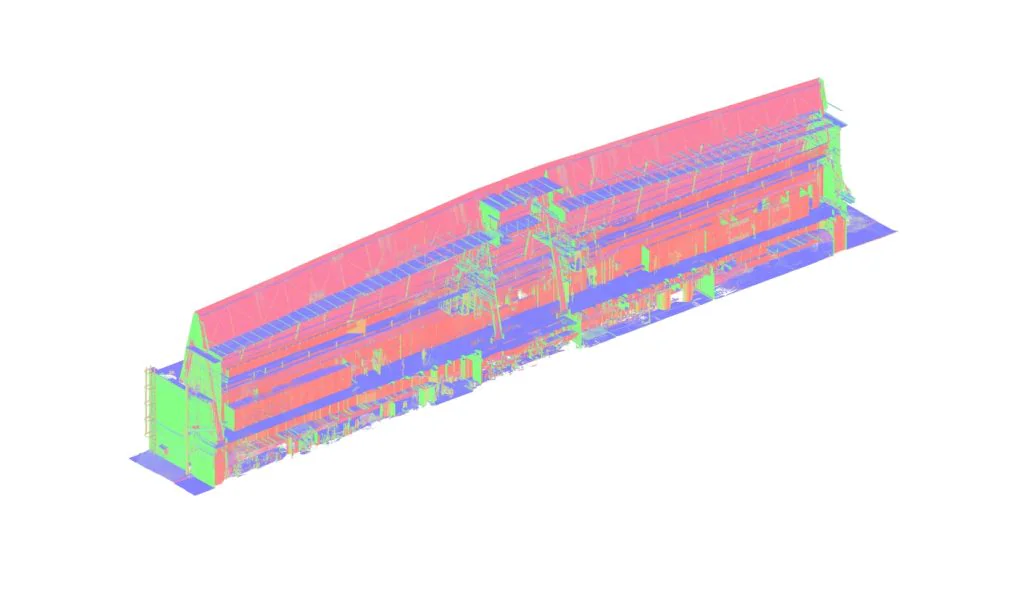
Multiple scan positions must be aligned into a unified coordinate system.
Using advanced algorithms, our team performs point cloud registration for chemical plants to merge scans into a consistent dataset representing the entire facility.
Registration accuracy is verified using control points and geometric alignment checks.
3. Cleaning and Filtering
Once registered, the dataset undergoes point cloud cleaning and filtering to remove:
- noise clusters
- atmospheric interference
- temporary objects
- scanning reflections
Filtering significantly improves model clarity and reduces file size while preserving critical equipment details.
4. Segmentation and Plant Zoning

Large process plants are divided into logical zones using point cloud segmentation for industrial plants.
Common segmentation categories include:
- process units
- pipe racks
- equipment areas
- tank farms
- structural zones
Segmentation allows engineering teams to work with manageable datasets rather than navigating an entire plant scan simultaneously.
5. Modeling and Data Conversion
Depending on project requirements, the processed data may be converted into engineering models.

This includes:
- point cloud to CAD for chemical facilities
- equipment modeling
- piping system reconstruction
- structural modeling
This stage is often part of a broader scan-to-BIM workflow used for plant modernization projects.
Types of Data Generated from Chemical Plant Point Clouds
Professional point cloud processing for chemical facilities produces multiple types of deliverables used by engineering teams.
| Data Type | Description | Typical Use |
| Cleaned Point Clouds | Noise-filtered and optimized scan datasets with improved clarity | Visualization, engineering review |
| Registered Point Clouds | Multiple scan positions aligned into a single coordinate system | Facility-wide analysis and measurements |
| Segmented Plant Areas | Point clouds divided into process units or equipment zones | Engineering workflows and modeling |
| Piping System Datasets | Isolated point clusters representing pipe networks | Piping reconstruction and modification planning |
| CAD-Compatible Data | Structured point clouds optimized for CAD modeling | Engineering design and plant documentation |
These structured outputs enable efficient use of scan data within engineering platforms.
Engineering Applications of Point Cloud Data in Chemical Plants
Processed scan data supports a wide range of engineering and operational tasks in chemical manufacturing facilities.
Plant Revamp and Retrofit Projects
Many chemical plants operate for decades and undergo multiple modifications.
Accurate point cloud datasets allow engineers to evaluate available space for new equipment, piping tie-ins, and structural upgrades.
This reduces field measurements and improves engineering reliability.
Piping System Documentation
Chemical plants often contain undocumented or outdated piping layouts.
Through point cloud modeling of piping systems, engineers can reconstruct accurate piping networks directly from scan data.
This supports:
- process redesign
- pipe stress analysis
- equipment relocation
Equipment Replacement Planning
Reactors, heat exchangers, pumps, and other process equipment require periodic replacement.
Point cloud data provides accurate spatial measurements for installation planning, ensuring new components fit existing infrastructure.
Safety and Compliance Analysis
Processed scan data enables accurate spatial analysis of safety-critical areas.
This includes evaluation of:
- evacuation routes
- maintenance access clearances
- safety valve accessibility
- hazardous equipment proximity
Accurate facility documentation improves compliance with industrial safety standards.
Digital Twin Development
Chemical manufacturers increasingly develop digital twins of their facilities to support long-term asset management.
Processed point cloud datasets serve as the geometric foundation for these digital environments.
They allow plant operators to visualize existing infrastructure, plan upgrades, and monitor facility performance within a digital model.
FAQ
What is point cloud processing for chemical plants?
Point cloud processing for chemical plants is the workflow of converting raw laser scanning data into structured datasets suitable for engineering analysis. It includes registration, filtering, segmentation, and modeling of plant infrastructure.
Why is point cloud registration important for chemical facilities?
Chemical plants are scanned from many positions. Point cloud registration for chemical plants aligns these scans into a single coordinate system so the entire facility can be analyzed accurately.
Can point cloud data be converted into CAD or BIM models?
Yes. Processed datasets can be converted using point cloud to CAD for chemical facilities or integrated into scan-to-BIM workflows to create engineering models of piping systems, equipment, and structural elements.
How accurate is laser scan data processing for chemical plants?
Modern laser scan data processing for chemical plants can maintain millimeter-level accuracy when proper registration and filtering workflows are used.
What plant components can be modeled from point cloud data?
Typical elements include piping networks, reactors, distillation columns, heat exchangers, tanks, pipe racks, and structural steel frameworks.

