

3D Scanning for Reverse Engineering in San Francisco, CA
ScanM2 provides 3D scanning for reverse engineering in San Francisco for repair shops, manufacturers, maintenance teams, labs and product designers. We scan a physical part, a tool or an installed component and rebuild it as an editable CAD model, a mesh or a set of 2D drawings, even when no original drawings exist.
Contact Us Now for a Free Consultation!
We have no office in San Francisco. Our crew travels to sites in the city and anywhere in California, or you can ship smaller parts to us. If you already have scan data, send it and we will check whether it is good enough for modeling. The full service, including how we work and what we deliver, is described on our national reverse engineering services page.
Who Needs Reverse Engineering in San Francisco
San Francisco is not a city of large factories, but a lot of making and fixing still happens here. The Planning Department describes production, distribution and repair (PDR) as a modest but critical part of the city’s economy and tracks the remaining industrial land in the Eastern Neighborhoods. Small shops like these rarely have CAD files for the machines they keep running.
| Who | Typical part | Why the drawing is missing |
|---|---|---|
| Machine and fabrication shops | Gears, shafts, brackets, housings, jigs | The part came with a used machine or was made by hand decades ago |
| Food and beverage producers | Guides, change parts, scraper blades, covers | The equipment maker is gone or quotes a long wait for a spare |
| Building engineers | Pump impellers, valve parts, fan hubs, elevator and door hardware | Old buildings run on equipment older than any digital record |
| Labs and life science companies | Instrument brackets, fixtures, enclosures, adapter plates | Fixtures were modified in-house and never redrawn |
| Aircraft maintenance suppliers | Tooling, ground equipment parts, test fixtures | Tooling drawings are lost or do not match the tool in use |
| Restorers and fabricators | Cast ornaments, balusters, brackets, hardware for older houses | The original pattern no longer exists |
Mission Bay grew into a bioscience district around the UCSF campus, and lab teams there often need a holder or adapter that fits an existing instrument. Restorers of decorative castings can also see our page on reverse engineering for historical buildings.
What to Order: Mesh, Surfaces, Solid Model or Drawing?
The most common mistake is ordering the wrong deliverable. A mesh is quick to make, but a machinist cannot change it easily. Choose by what happens next with the file.
| Your next step | What to order | Typical formats |
|---|---|---|
| 3D print a copy or a fit-test sample | Clean, watertight mesh | STL, OBJ, PLY |
| Reproduce a freeform shape (casting, ornament, ergonomic housing) | Surface model fitted to the scan | STEP, IGES |
| Machine, modify or re-tolerance a part | Parametric solid with a feature tree | SolidWorks, STEP, Parasolid X_T |
| Order the part from a shop or a supplier | Solid model plus 2D drawing with dimensions | STEP, DWG, DXF, PDF |
| Design a new part around an existing machine | Solid of the part plus scan of its surroundings | STEP plus E57 or RCP point cloud |
Not sure? Tell us how the part will be made and by whom. Our article on turning a point cloud into a mesh explains where a mesh is enough and where it is not.
Worn, Broken or Modified: What the Model Should Show
A scan records the part as it is today, with wear, dents and paint. A good reverse engineering model shows the part as it should be. Before modeling, we agree a few rules with you:
- Wear: worn faces are rebuilt to their original shape where the remaining geometry shows it, such as a round bore or a flat seat.
- Symmetry: if one side of a part is damaged, the intact side can be mirrored.
- Standard sizes: holes, threads and bearing seats can be snapped to standard values when you confirm them.
- Broken parts: send all the pieces. Missing areas are modeled from the mating part or from your input and marked on the drawing.
- Field modifications: decide whether the model should include a weld, a slot or a drilled hole someone added later. Sometimes that change is the reason the part works.
If the original part failed, it may be worth changing it slightly, for example a thicker rib or a larger radius. The design decision stays with your engineer; we model the agreed change.
What a Scanner Cannot Capture
A 3D scanner sees surfaces it has a line of sight to. Plan for these limits before you send a part:
- Deep bores, internal channels and blind holes: only the visible depth is captured. Inner diameters are measured by hand or taken from the mating part.
- Threads: scanned as rough shapes. We model them from the thread size you confirm.
- Shiny, black or transparent surfaces: may need a temporary matte spray. Tell us if your part must not be sprayed.
- Tight tolerances: a fit between a shaft and a bearing is checked against the standard or measured with gauges, not read from the scan alone.
- Material and hardness: a scan gives shape only. Material, heat treatment and coatings come from your records or a lab.
How accurate the result is depends on the scanner, the size of the part and its surface. We agree the required tolerance before scanning and choose the scanner to suit it.
Scanning a Part Without Removing It
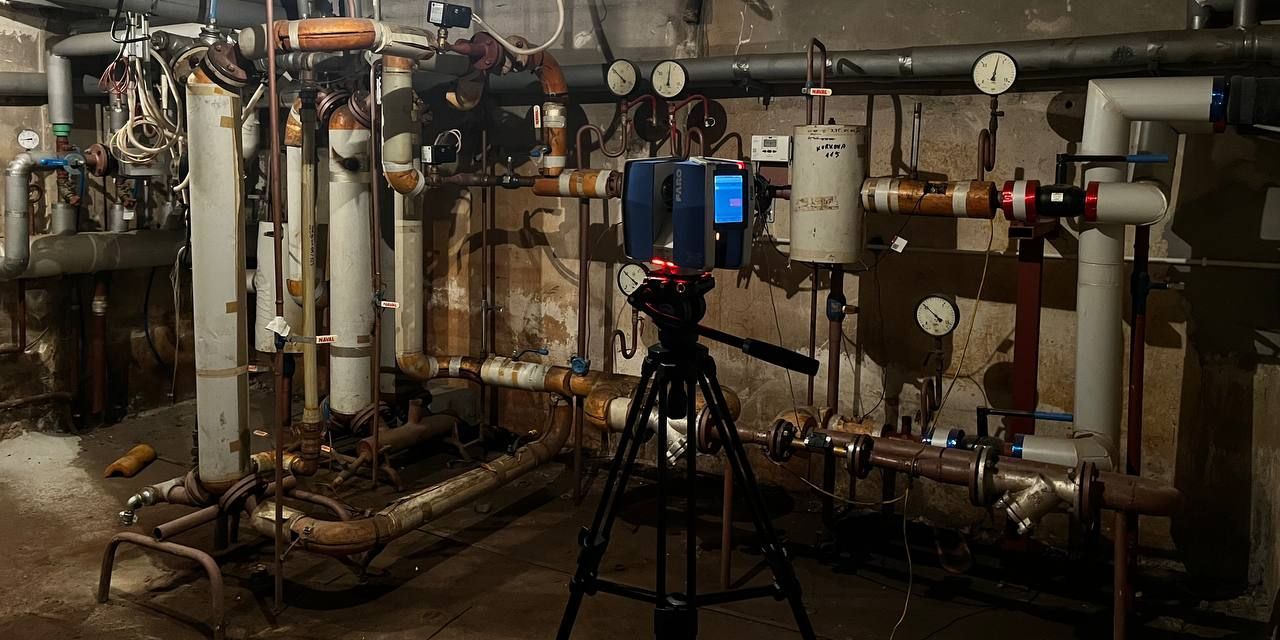
Some parts cannot leave the building, for example a large fan housing, a pump casing bolted to its base or a guide inside a production line. We scan them in place with a handheld scanner. If a new part must fit between existing pipes, ducts or frames, we also scan the surroundings with a FARO tripod scanner. Typical accuracy for that room-scale scan is ±2–3 mm, which is suitable for clearances, not for machined fits.
For older buildings with tight access, please arrange:
- A freight elevator or a route for equipment cases to the mechanical room.
- Lockout of the machine and a site contact who can open guards.
- Lighting and space of about one meter around the part.
- Permission to place small reference targets on the part or nearby.
Large installed equipment is covered in more detail on our page for reverse engineering of industrial equipment and machinery.
Aircraft and Medical Parts: Where Our Work Stops
United Airlines has called its Maintenance Operations Center at SFO its largest maintenance facility, and many suppliers around the airport make tooling and support equipment. We can scan and model tooling, fixtures and test equipment. A replacement part for installation on a certified aircraft is a different matter: federal rules in 14 CFR 21.9 limit who may produce such parts and how. We supply geometry; approval and production stay with the holder of the right approvals.
The same applies to medical devices and regulated lab equipment. Our model can be an input to your design process, but validation follows your own quality system.
Sample Scope You Can Copy
- Part: cast iron pump impeller, about 250 mm diameter, one blade chipped
- Goal: new impeller from a local foundry and machine shop
- Deliverables: surface model of the blades, solid model of hub and keyway, 2D drawing with main dimensions
- Rules: rebuild the chipped blade from the intact ones, bore and keyway to standard sizes confirmed by the client
- Files: STEP, SolidWorks part, PDF and DWG drawing, STL for a test print
This is an example, not one of our projects. Change the part, rules and files to match yours.
Working south of the city? See 3D scanning for reverse engineering in San Jose.
FAQ
What does 3D scanning for reverse engineering include?
Do I need to ship the part, or can you scan it in San Francisco?
How accurate is reverse engineering from a 3D scan?
Can you reverse engineer a worn or broken part?
Which file formats do you deliver?
Can you make a replacement part for an aircraft?
Is it legal to reverse engineer a part?
Do you have an office in San Francisco?
What to Send Us
- Photos of the part from several sides, with a ruler in the frame
- Approximate size, weight and material
- What the result is for: copy, modification, 3D print or supplier order
- Mating parts or the machine it fits, if available
- Required file formats and CAD software version
- Whether the part can be shipped or must be scanned on site, and the site address
We handle your parts and files confidentially. Please make sure you have the right to reproduce the part; patents and design rights belong to their owners. For work in Southern California, see our reverse engineering in Los Angeles page. For buildings and sites in the city, see 3D scanning in San Francisco.
Send us photos and a short description, and we will suggest the scanner, the deliverable and the modeling rules for your part.

