

Digital Twin vs BIM: What’s the Difference?
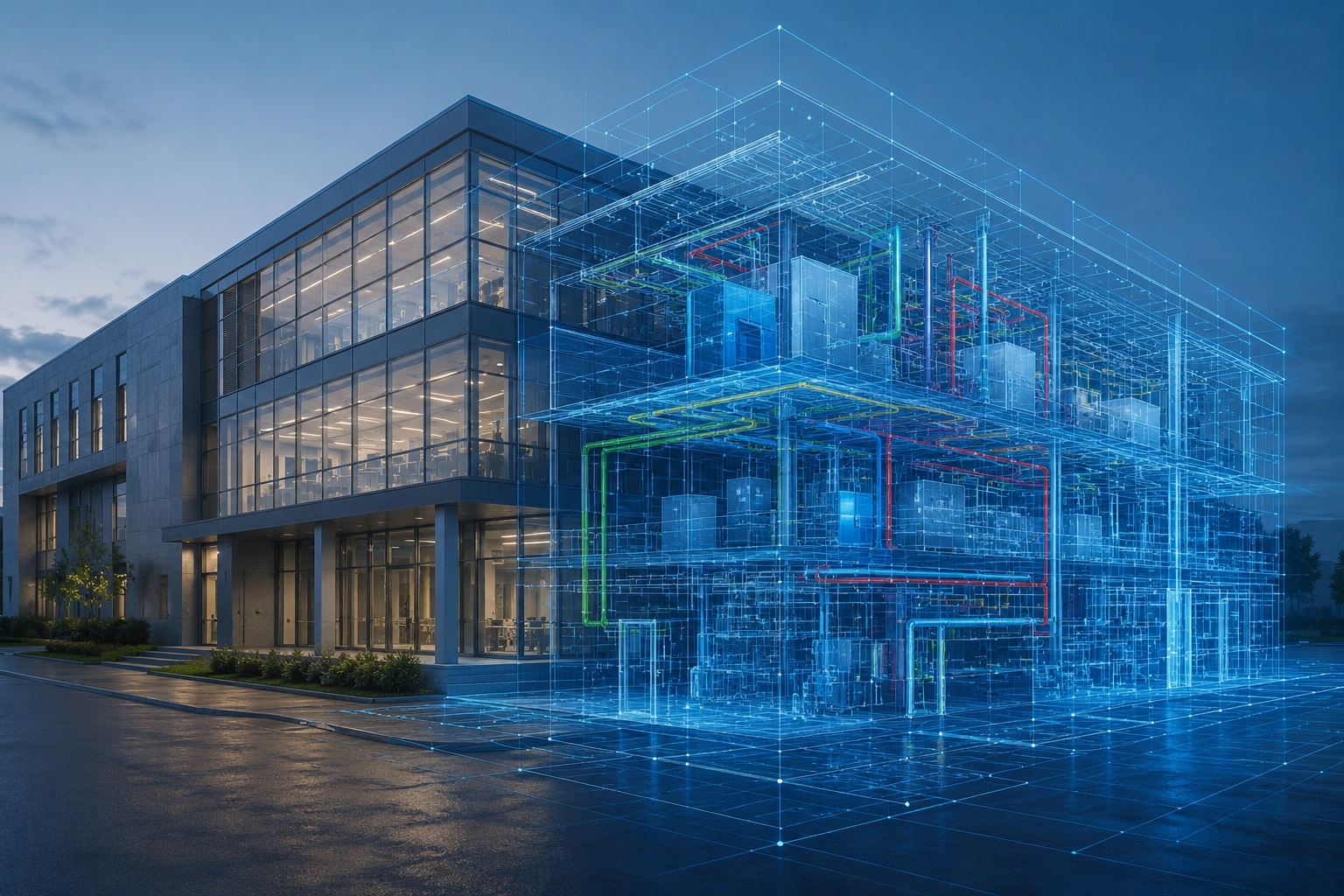

Why Are BIM and Digital Twins Often Confused?
The terms Building Information Modeling (BIM) and Digital Twin are frequently used interchangeably. Both involve digital representations of physical assets, support better decision-making, and help improve building lifecycle management.
However, they are not the same.
A BIM model is primarily created to support design, construction, and documentation. A Digital Twin extends that model by connecting it with real-world operational data, allowing owners and facility managers to monitor, analyze, and optimize a building throughout its lifecycle.
Understanding the difference is essential when planning renovation projects, facility upgrades, or long-term asset management.
What Is BIM?
Building Information Modeling (BIM) is a digital representation of a building that combines geometry with structured project information.
A BIM model may include:
- architectural elements;
- structural systems;
- MEP installations;
- dimensions and quantities;
- construction documentation;
- material information;
- object properties.
Unlike traditional 2D drawings, BIM allows architects, engineers, contractors, and owners to work within a coordinated digital environment.
Professional BIM Modeling Services help create accurate models for design, construction, renovation, and facility management projects.
What Is a Digital Twin?
A Digital Twin goes beyond geometry.
It combines a BIM model with continuously updated information collected from the real building.
A Digital Twin may integrate:
- IoT sensors;
- building management systems;
- HVAC monitoring;
- electrical consumption;
- environmental data;
- occupancy information;
- equipment performance;
- maintenance records.
Instead of representing only how a building was designed, a Digital Twin reflects how it performs in real time.
BIM vs Digital Twin: The Key Differences
Although both technologies use digital building models, their purpose is different.
| BIM | Digital Twin |
|---|---|
| Used during design and construction | Used during building operation |
| Static project information | Dynamic real-time information |
| Focus on project delivery | Focus on building performance |
| Supports coordination | Supports monitoring and optimization |
| Updated when project changes | Continuously updated through live data |
A Digital Twin usually begins with a BIM model, but expands far beyond traditional project documentation.
How Does a BIM Model Become a Digital Twin?

Creating a Digital Twin is not a single step—it is a process.
A typical workflow includes:
- 3D Laser Scanning Services capture accurate existing conditions.
- Point cloud data is processed and registered.
- Professional Scan to BIM Services transform scan data into a structured BIM model.
- Asset information is added.
- Operational systems and IoT sensors are connected.
- The building becomes a living Digital Twin.
Without accurate geometry at the beginning of the process, the Digital Twin cannot provide reliable information.
Why Accurate Existing Conditions Matter
Many existing buildings have undergone years of renovations, equipment replacements, and undocumented modifications.
Original drawings often no longer reflect reality.
Accurate Existing Conditions Documentation provides a reliable foundation before BIM modeling or Digital Twin implementation begins.
Using outdated drawings can introduce costly errors that affect planning, coordination, and facility management.
Laser scanning eliminates these uncertainties by capturing the building exactly as it exists today.
Where Are Digital Twins Used?
Digital Twins are becoming standard across many industries.
Typical applications include:
- commercial buildings;
- manufacturing facilities;
- airports;
- hospitals;
- universities;
- industrial plants;
- warehouses;
- infrastructure projects;
- data centers.
As facilities become more complex, Digital Twins provide owners with a continuously updated view of their assets.
Why Data Centers Benefit Most from Digital Twins

Data centers are among the most technically complex buildings in operation.
They contain thousands of interconnected systems including:
- cooling infrastructure;
- electrical distribution;
- server racks;
- cable management;
- fire protection;
- security systems;
- backup power equipment.
Maintaining accurate documentation is critical.
Many operators therefore implement Digital Twin and 3D Scanning for Modern Data Centers to improve planning, modernization, maintenance, and long-term asset management.
When Is BIM Enough?
Not every project requires a Digital Twin.
A BIM model is often sufficient for:
- new construction;
- renovation projects;
- design coordination;
- clash detection;
- permit documentation;
- quantity takeoffs;
- construction planning.
For many architectural and engineering projects, BIM delivers all the information required.
When Should You Invest in a Digital Twin?
A Digital Twin provides additional value when buildings remain in operation for many years.
It is particularly beneficial when organizations need:
- continuous asset monitoring;
- predictive maintenance;
- operational analytics;
- energy optimization;
- facility management;
- space utilization analysis;
- lifecycle planning.
The larger and more complex the facility, the greater the long-term value of a Digital Twin.
BIM and Digital Twins Work Together
Rather than replacing BIM, a Digital Twin builds upon it.
BIM provides the accurate digital foundation.
The Digital Twin continuously enriches that model with operational information collected throughout the building’s lifecycle.
Together they support better design decisions, more efficient operations, lower maintenance costs, and improved asset performance.
Conclusion
BIM and Digital Twins serve different — but complementary — purposes.
BIM focuses on designing, documenting, and coordinating buildings before and during construction.
Digital Twins extend that information into the operational phase by combining BIM models with real-time building data.
When combined with laser scanning, point cloud processing, and accurate existing conditions documentation, both technologies help owners make better decisions throughout the entire lifecycle of a facility.
Looking to Build a Digital Twin?
ScanM2 provides 3D laser scanning, point cloud processing, BIM modeling, Scan-to-BIM services, and Digital Twin solutions for commercial, industrial, and mission-critical facilities.
Our team helps owners create accurate digital building information that supports renovation, facility management, and long-term operational planning.
FAQ
Is BIM the same as a Digital Twin?
Can a BIM model become a Digital Twin?
Does every BIM project require a Digital Twin?
Can laser scanning be used to create a Digital Twin?
Why are accurate existing conditions important?

INTERGEO: How Laser Scanning Is Becoming a Foundation for Management and Decision-Making
24.09.2026
ScanM2 once again took part in INTERGEO, which was held in Munich this year. For us, the event is an opportunity to meet with partners, ...

How 3D Laser Scanning Measures Floor Flatness and Levelness
22.09.2026
Floor flatness and levelness can directly affect equipment installation, racking systems, automated material handling, production lines, flooring systems, and other construction activities that depend on ...

How 3D Laser Scanning Supports Construction Claims and Dispute Resolution
24.08.2026
Construction claims and disputes often arise when project participants disagree about what was actually built, when specific work was completed, whether installed elements match the ...

Point Cloud Cleaning Explained: How Scan Data Is Prepared for CAD and BIM
19.08.2026
3D laser scanning can capture millions or even billions of measurement points across an existing building, industrial facility, or construction site. However, the raw dataset ...

