

Scan to BIM Services for Monuments of Architecture and Archaeology
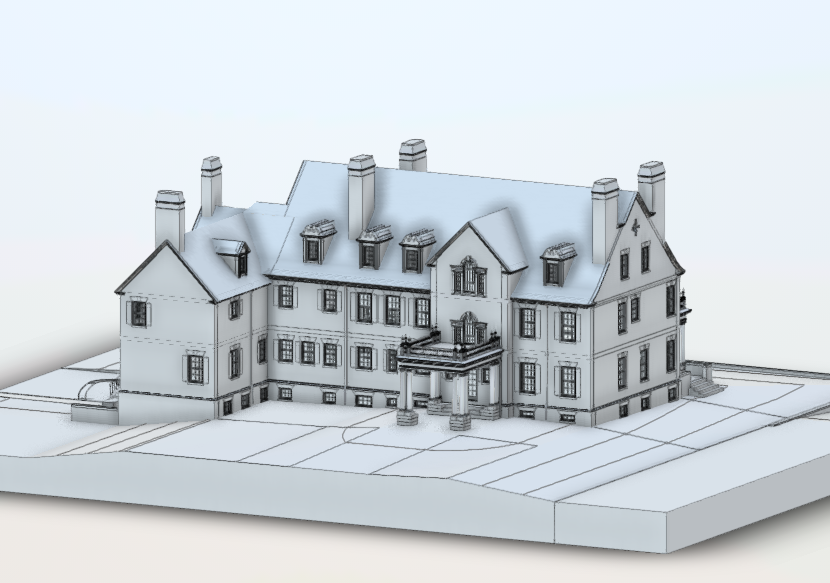
Monuments of architecture and archaeological sites require BIM models that accurately preserve existing conditions while supporting restoration, conservation, and long-term heritage management. Unlike conventional buildings, heritage assets often feature irregular geometry, weathered materials, unique craftsmanship, and architectural elements that cannot be recreated using standard modeling approaches.
At ScanM2, we provide professional Scan to BIM services for monuments of architecture and archaeology, converting high-density laser scan data into intelligent BIM models for architects, engineers, conservation specialists, archaeologists, and heritage organizations. Our models provide reliable digital documentation for restoration planning, structural analysis, project coordination, and future maintenance.
Contact Us Now for a Free Consultation!
Whether documenting historical monuments, archaeological remains, museums, castles, or UNESCO heritage sites, our Scan to BIM workflow delivers accurate digital models while preserving the authenticity of every structure.
From Reality Capture to Intelligent BIM Models
Every successful heritage BIM project begins with accurate existing conditions documentation. Using our 3D Laser Scanning Services for Monuments of Architecture and Archaeology, millions of measurement points are collected without physical contact, capturing the true geometry of the monument.
The collected point cloud is then transformed into an intelligent BIM model that accurately reflects existing conditions rather than idealized architectural geometry. This enables restoration teams to work from reliable digital information throughout every stage of the project.
Why BIM Is Essential for Heritage Conservation
Historic monuments require far more than visual documentation.
Intelligent BIM models help project teams:
- document existing conditions
- coordinate multidisciplinary restoration projects
- identify structural issues
- manage heritage assets
- reduce field measurements
- improve restoration planning
- preserve historical information for future generations
By integrating geometric accuracy with engineering information, BIM becomes a valuable tool throughout the lifecycle of a heritage asset.
Our Scan to BIM Workflow
Reality Capture
Every project starts with high-resolution terrestrial laser scanning that records the complete geometry of the monument.
Point Cloud Preparation
Collected datasets are registered and optimized through our Point Cloud Processing Services for Monuments of Architecture and Archaeology, ensuring reliable data for modeling.
BIM Development
Our specialists create intelligent BIM models containing architectural and structural information required for restoration and conservation.
Quality Assurance
Every modeled element is validated against the original point cloud to maintain geometric accuracy.
Project Delivery
The completed BIM model supports restoration planning, engineering coordination, conservation documentation, and long-term asset management.
Project Example: Historic Brooklyn Mansion
ScanM2 delivered a complete Scan to BIM workflow for the restoration of a historic 1899 Brooklyn mansion, providing architects with accurate digital documentation for renovation while preserving the building’s architectural character.
Using high-precision terrestrial laser scanning, our team captured the complete interior and exterior of the two-story residence. The verified point cloud was converted into an intelligent BIM model, allowing architects to accurately coordinate restoration work, redesign interior spaces, and develop reliable construction documentation without repeated site visits.
3D Model and Blueprints For NY House Restoration


The final deliverables included detailed floor plans, façade elevations, ceiling plans, and a comprehensive Archicad BIM model with 2 mm accuracy. By transforming reality capture data into an intelligent digital model, the project reduced design risks, improved interdisciplinary coordination, and accelerated the entire restoration planning process.
BIM Deliverables
Depending on project requirements, we provide:
- architectural BIM models
- structural BIM models
- Revit models
- Archicad models
- LOD 200–400
- existing conditions models
- BIM documentation
- coordinated digital models
- restoration-ready BIM datasets
- IFC and native project files
Projects requiring higher levels of detail can also benefit from our BIM Modeling Services for Monuments of Architecture and Archaeology and detailed As-Built Drawings for Monuments.
Applications
Our Scan to BIM services support:
Heritage Restoration
Accurate BIM models simplify restoration planning and interdisciplinary coordination.
Archaeological Documentation
Digital models preserve valuable historical information for future research and conservation.
Facility Management
BIM models continue to provide value after restoration by supporting maintenance and long-term asset management.
Digital Preservation
Intelligent models create permanent digital archives of culturally significant monuments.
Engineering Analysis
Reliable geometry supports structural assessments, renovation planning, and future interventions.
Why Choose ScanM2
Heritage Scan to BIM projects require both technical expertise and a deep understanding of historical architecture.
ScanM2 combines advanced laser scanning technologies, BIM expertise, and extensive experience with complex heritage documentation projects. Our team delivers highly accurate digital models that support architects, engineers, conservation specialists, and restoration teams throughout every phase of the project.

