

3D Laser Scanning for Historical buildings
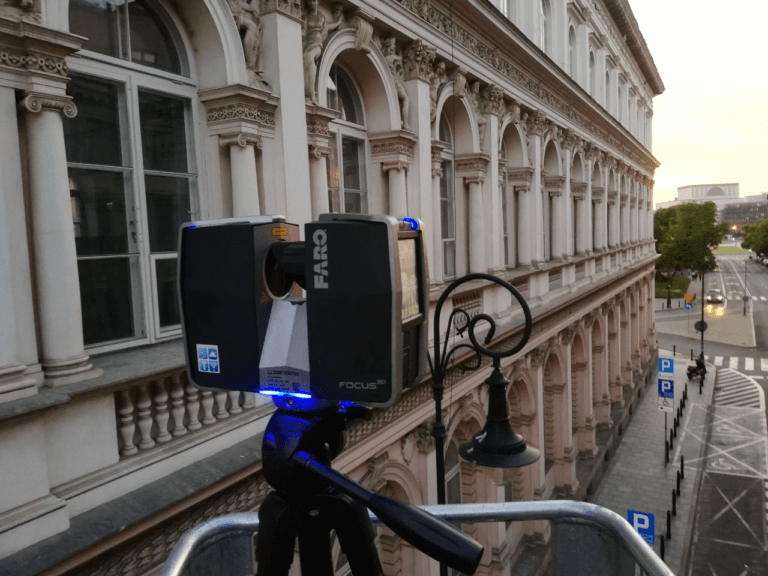
Historical buildings require highly accurate documentation before restoration, renovation, structural assessment, or adaptive reuse. Traditional surveying methods often cannot capture complex architectural details, irregular geometries, decorative façades, vaulted interiors, or centuries of structural modifications with the precision required for engineering projects.
At ScanM2, we provide professional 3D laser scanning services for historical buildings, delivering accurate point cloud data for architects, engineers, restoration specialists, conservation teams, and BIM professionals. Our laser scanning technology captures millions of measurements to create a precise digital representation of existing conditions while preserving every architectural detail.
Contact Us Now for a Free Consultation!
Why Historical Buildings Require 3D Laser Scanning
Historic structures often differ significantly from modern buildings. Multiple reconstruction phases, architectural alterations, structural settlement, and decorative elements create geometries that cannot be documented accurately using conventional measurement techniques.
3D laser scanning for historical buildings provides comprehensive digital documentation without physical contact with sensitive architectural elements, making it an ideal solution for conservation and restoration projects.
Accurate scan data supports restoration planning, engineering analysis, renovation, structural monitoring, heritage conservation, and digital preservation.
Challenges of Surveying Historical Buildings
Historic buildings present numerous surveying challenges that require advanced reality capture technologies.
Complex Architectural Geometry
Historic façades frequently include arches, cornices, balconies, towers, vaults, decorative stonework, sculptures, and irregular wall surfaces that demand high-density scanning.
Irregular Building Dimensions
Many heritage buildings have experienced structural movement over decades or centuries. Walls may not be vertical, floors may be uneven, and original geometry often differs from design documentation.
Decorative Architectural Details
Columns, capitals, moldings, ornaments, reliefs, staircases, and historical interiors require millimeter-level accuracy to support restoration work.
Limited Access
Many historical buildings remain operational as museums, public buildings, hotels, or cultural facilities. Laser scanning minimizes disruption while rapidly capturing complete datasets.
Preservation Requirements
Non-contact surveying techniques help protect fragile architectural elements and comply with conservation requirements.
Our 3D Laser Scanning Workflow
Site Survey Planning
Every project begins with an assessment of the building, scanning objectives, required deliverables, and accessibility.
3D Laser Scanning
Our engineers perform comprehensive historical building laser scanning, capturing interior and exterior geometry using high-precision terrestrial laser scanners.
Point Cloud Registration
Captured scans are accurately aligned into a unified coordinate system through our Point Cloud Processing Services for Historical Buildings, creating a complete digital representation of the building.
Quality Control
Each dataset undergoes registration verification, accuracy checks, and completeness review before delivery.
Final Deliverables
Clients receive high-quality point cloud data ready for:
- Scan to BIM Services for Historical Buildings
- BIM Modeling Services for Historical Buildings
- As-Built Drawings Services for Historical Buildings
- Reverse Engineering Services for Historical Buildings
Project Example: National Museum of Ethnography
One of ScanM2’s heritage documentation projects involved 3D laser scanning and BIM development for the restoration of the National Museum of Ethnography.
The objective was to create an accurate digital representation of the entire historic building, including façades, interiors, roof structures, stained-glass windows, and architectural details. Using high-precision terrestrial laser scanning, our team captured the complete geometry of the museum and generated a detailed point cloud for further processing.
The collected data was used to develop an accurate BIM model and extract comprehensive 2D documentation, including floor plans, elevations, and sections. The resulting deliverables provided architects and restoration specialists with reliable existing conditions documentation for conservation planning and restoration works while preserving the historical integrity of the building.
Gallery of Historical Building Laser Scanning Projects
Explore examples of our 3D laser scanning projects for historical buildings, including museums, heritage landmarks, historic residences, castles, public buildings, and restoration projects. The gallery demonstrates the level of detail captured for restoration, conservation, BIM modeling, and engineering documentation.
National Museum of Ethnography Project Example




What Can Be Captured
| Architectural Element | Documentation |
|---|---|
| Building façades | ✔ |
| Historic interiors | ✔ |
| Vaulted ceilings | ✔ |
| Columns and capitals | ✔ |
| Staircases | ✔ |
| Decorative ornaments | ✔ |
| Balconies and cornices | ✔ |
| Roof structures | ✔ |
| Towers and domes | ✔ |
| Structural elements | ✔ |
Applications
Our 3D laser scanning services for historical buildings support a wide range of engineering and conservation projects, including:
- heritage restoration;
- conservation planning;
- adaptive reuse;
- structural assessment;
- architectural documentation;
- renovation projects;
- BIM development;
- digital preservation;
- facility management;
- engineering coordination.
Why Choose ScanM2
Working with historical buildings requires both surveying expertise and an understanding of heritage documentation standards.
With ScanM2, clients receive:
- millimeter-level measurement accuracy;
- non-contact surveying technology;
- complete interior and exterior documentation;
- fast data acquisition;
- comprehensive quality control;
- deliverables compatible with CAD and BIM software;
- experienced specialists in complex heritage projects;
- scalable solutions for buildings of any size and complexity.

